

Research use only. This compound is supplied for in-vitro laboratory research by qualified researchers. It is not for human or veterinary consumption and has not been evaluated by the FDA.
Metabolic Research
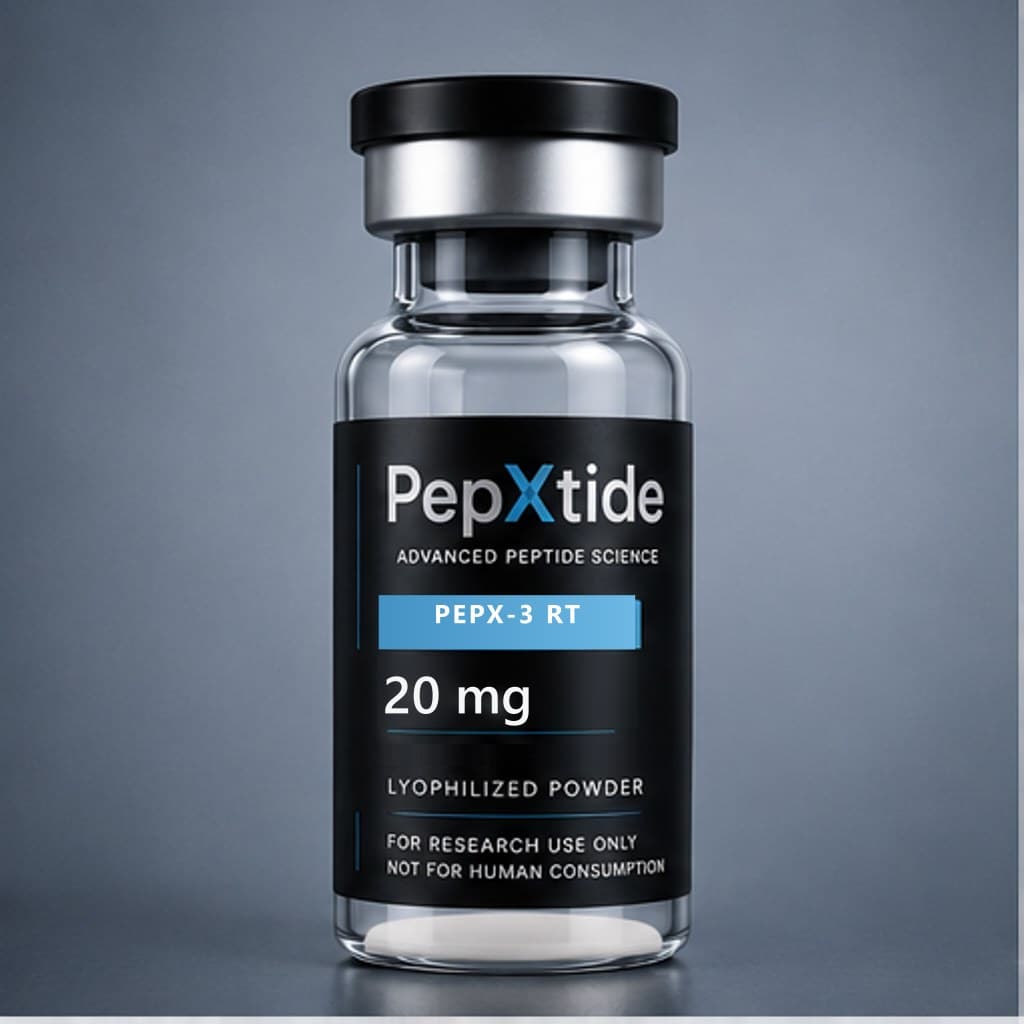
GLP-3 (Retatrutide) 20mg
Certificate pending · 20mg
20mg$159.99each
$8.00/mg
GLP-3 (Retatrutide) is a 39-residue lipopeptide studied as a triple agonist at the GLP-1, GIP and glucagon receptors. Three positions carry non-standard residues: alpha-aminoisobutyric acid at 2 and 20, and alpha-methyl-leucine at 13. All three are modelled explicitly in the PepXtide structural library.
One honest caveat about the 3D model: the C20 fatty diacid on Lys17 is a lipid tail and is not drawn, so the mass shown by the viewer is the peptide backbone alone rather than the 4,731.33 g/mol figure for the complete molecule.
Like its dual-agonist relative in this catalogue, the compound is built on a GIP backbone rather than a GLP-1 one, and was developed at Eli Lilly, with the originating characterisation published in 2022. The stated design intent was to protect the sequence from dipeptidyl peptidase IV recognition and to raise activity at the GIP and glucagon receptors while retaining activity at the GLP-1 receptor.
The pattern of non-standard residues differs from the dual agonist in a way that is easy to get wrong. Here the two alpha-aminoisobutyric acids sit at positions 2 and 20, and position 13 carries alpha-methyl-leucine rather than a second aminoisobutyric acid. The acylation site also differs: the diacid hangs from lysine 17, not lysine 20, and reaches the chain through a gamma-glutamate and a single oligoethylene-glycol spacer rather than two. The diacid itself is the same C20 eicosanedioic acid in both compounds, and it is the albumin-binding element that extends residence. The C-terminus is a serine amide.
All three receptors are class B1 G-protein-coupled receptors. Reported cyclic AMP half-maximal concentrations are roughly 0.064 nanomolar at the GIP receptor, 0.775 nanomolar at the GLP-1 receptor and 5.79 nanomolar at the glucagon receptor, so the compound is not equipotent across its three targets; relative to the endogenous ligands it is described as more potent at the GIP receptor and somewhat less potent at the other two. Published binding constants appear mainly on vendor pages rather than in primary literature and are not reproduced here.
Structural and mechanistic work uses cryo-electron microscopy of the compound bound to each of the three receptors in complex with Gs, alongside molecular dynamics and alanine-scanning mutagenesis of the receptors, with cyclic AMP accumulation read out against the mutant panel. Analytical characterisation in the published work is by validated liquid chromatography with high-resolution mass spectrometry.
A specification caution that catches people out. A regulatory substance registry lists a mass near 4,092 daltons for this compound, flagged as an estimate; that figure is the unmodified 39-residue backbone, excluding the lipid, the linker and the C-terminal amide. The figure published on this page, 4,731.33 g/mol, is the complete molecule.
Certificate pending for the 20mg lot.The signed report will be published here as soon as the laboratory returns it.
Ordering at volume or on a schedule?
Request a supply quote →Buy more of this strength and the price comes down. The store applies it at checkout - there is nothing to enter.
Free US shipping - no minimum
Tell us the lot number and what you observed. If independent testing shows a discrepancy against our published certificate, we refund the lot in full and pull it from sale pending investigation.
Tell us the lot number and what you observed. If independent testing shows a discrepancy against our published certificate, we refund the lot in full and pull it from sale pending investigation.
Certificate pending
Discreet packaging
Dispatched within one business day
Free US shipping, no minimum
Compound information
- Type
- Metabolic Research
- CAS number
- 2381089-83-2
- Molecular formula
- C221H342N46O68
- Molecular weight
- 4731.33 g/mol
- Sequence
- 39 residues with Aib at positions 2 and 20 and alpha-methyl-Leu at 13, C20 fatty diacid on Lys17
- Form
- Lyophilized powder
- Vial strength
- 20mg
- Catalogue number
- PX-3RT-20MG
- Purity
- Certificate pending for this strength
Identifiers are published properties of the molecule. Values we cannot confirm are omitted rather than estimated.
Background
GLP-3 (Retatrutide) is a 39-residue lipopeptide on a GIP backbone, developed at Eli Lilly with its originating characterisation published in 2022, and acting as a triple agonist at the GLP-1, GIP and glucagon receptors. It carries Aib at positions 2 and 20 and alpha-methyl-leucine at 13, a serine amide C-terminus, and a C20 eicosanedioic diacid on Lys17 attached through a gamma-glutamate and one oligoethylene-glycol spacer. It is not equipotent across its targets, being most potent at the GIP receptor.
Specifications
- Supplied as
- Lyophilized powder
- Available strengths
- 20mg
- CAS number
- 2381089-83-2
- Molecular formula
- C221H342N46O68
- Storage
- Store lyophilized at -20C, protected from light and moisture.
- Intended use
- In-vitro laboratory research only
Research overview
Triple incretin receptor agonist
A 39-residue lipopeptide studied as a GLP-1 / GIP / glucagon receptor triple agonist. Two positions carry Aib (2 and 20) and one carries alpha-methyl-leucine (13) - all three are modelled. The C20 fatty diacid on Lys17 is a lipid tail and is not drawn, so the mass shown is the peptide backbone only.
Aib at 2 and 20, alpha-methyl-Leu at 13, C20 fatty diacid on Lys17 (tail not shown).
- Residues
- 39
- Atoms
- 289
Primary literature
We have not compiled a reading list for this compound, and would rather show nothing than pad one out.
No public database record resolved for this compound under its catalogue name either. Rather than point you at a search that returns something else, this section stays empty.
PubMed, PubChem and ClinicalTrials.gov are independent scientific databases. A record or a published paper is not an endorsement of this product, and nothing indexed there describes an application, dose or outcome supported by PepXtide.
Storage & handling
Lyophilized
Store lyophilized at -20C, protected from light and moisture. The C20 diacid tail makes the molecule amphiphilic, so it adsorbs to surfaces and can aggregate at air-liquid interfaces; low-binding vessels, gentle handling and minimal time in dilute solution all help.
Reconstituted
Once reconstituted, keep refrigerated and use within the working period established by the laboratory.
Handling notes
- Store lyophilized at -20C, protected from light and moisture.
- The C20 diacid tail makes the molecule amphiphilic, so it adsorbs to surfaces and can aggregate at air-liquid interfaces.
- Use low-binding vessels, gentle handling and minimal time in dilute solution.
- Once reconstituted, keep refrigerated and use within the working period established by the laboratory.
Safety & handling
Bench handling, not a dosing guide.
Intended use
Supplied strictly as a laboratory research material for in-vitro study by qualified researchers. Not for human or veterinary use, not for ingestion or injection, and not for any clinical or diagnostic application.
Personal protective equipment
Handle with gloves, eye protection and a laboratory coat. Weigh and transfer lyophilized powder in a ventilated enclosure to avoid generating an inhalable dust.
Reconstitution
Reconstitute against the diluent and volume appropriate to your protocol, adding solvent slowly down the vial wall rather than directly onto the pellet. Do not shake. This is a handling note, not a dosing guide.
Storage after opening
Once reconstituted, refrigerate and use within the period appropriate to the material. Avoid repeated freeze-thaw cycles, which degrade peptides faster than continuous storage at the listed temperature.
Disposal
Dispose of material and containers in accordance with your institution's chemical waste procedures and applicable local regulations.
Related compounds
Metabolic Research
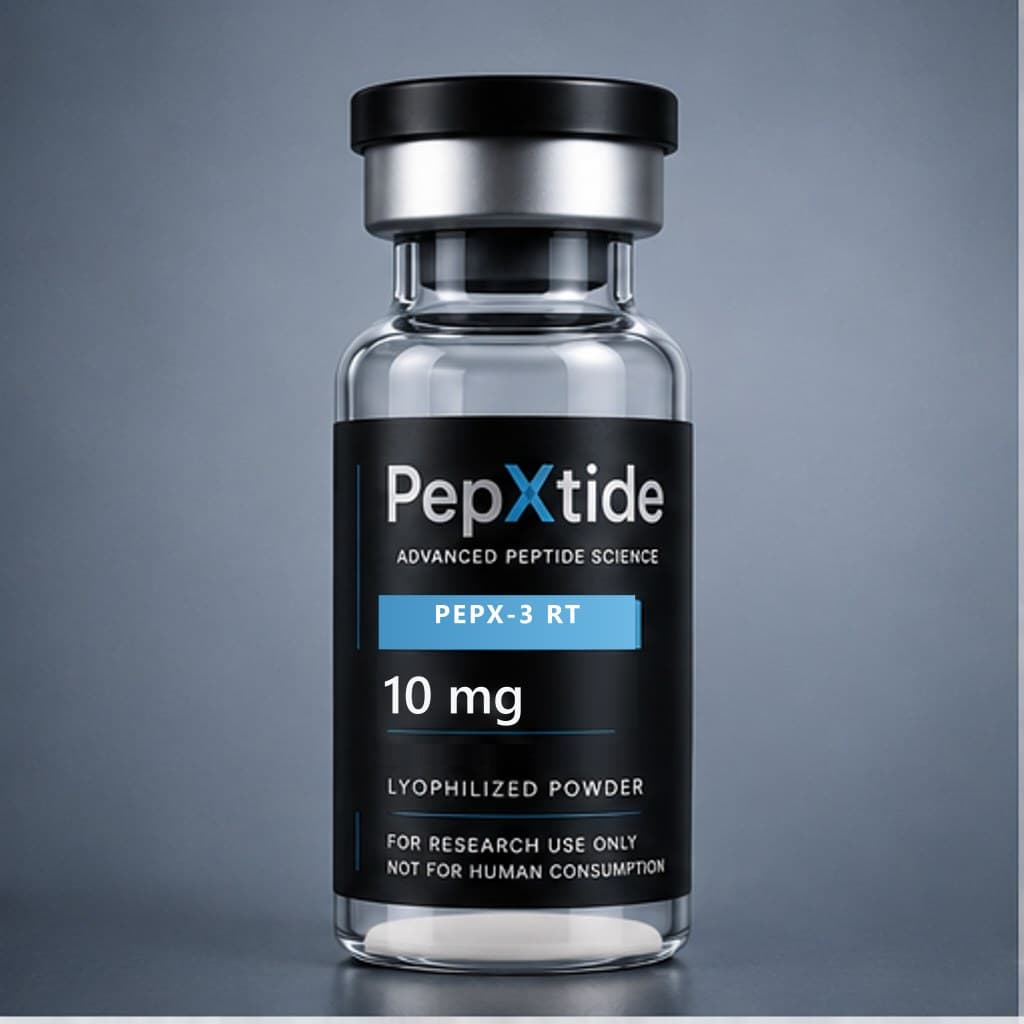
GLP-3 (Retatrutide) 10mg
Lyophilized powder
Metabolic Research
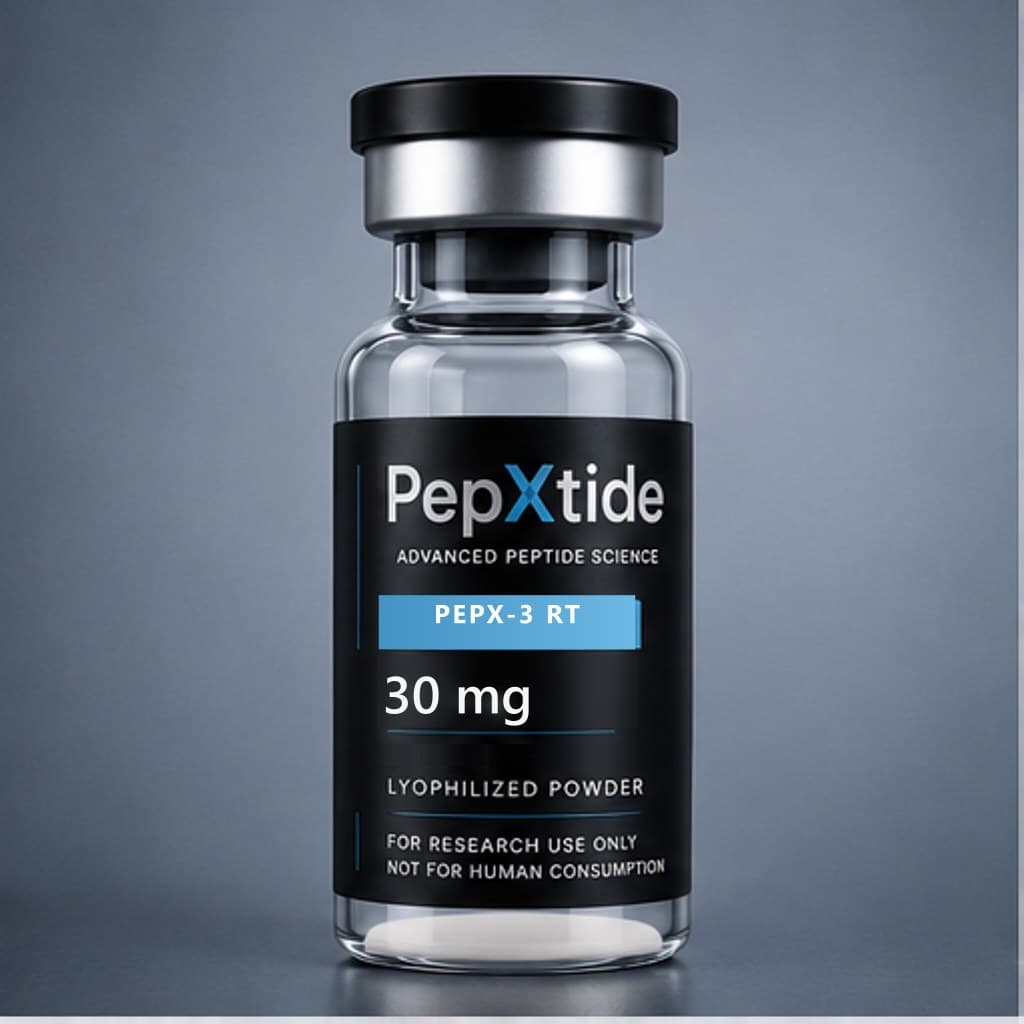
GLP-3 (Retatrutide) 30mg
Lyophilized powder

Metabolic Research
GLP-3 (Retatrutide) 60mg
Lyophilized powder
Metabolic Research
GLP-2 (Tirzepatide) 10mg
Lyophilized powder
Research notice
Supplied as a lyophilized powder for in-vitro laboratory research only. Not for human or veterinary consumption, and not approved by the FDA for any use. No statement on this page describes an application, benefit, dose, route or outcome. Descriptions are structural and mechanistic, and reference data such as CAS numbers and molecular formulas is published information about the compound itself, provided for identification. No measured result is shown for this strength because a certificate has not yet been published for its lot.