

Research use only. This compound is supplied for in-vitro laboratory research by qualified researchers. It is not for human or veterinary consumption and has not been evaluated by the FDA.

Cellular & Redox
Prostamax
Certificate pending · 20mg
20mg$65.00each
$3.25/mg
Prostamax is a synthetic tetrapeptide, Lys-Glu-Asp-Pro, from the Khavinson short-peptide bioregulator programme. The literature also uses the code KEDP, and one of Khavinson's own tables spells the name Prostomax.
The sequence is not inferred from vendor copy. The first claim of the European patent EP1353939B1 reads, in full, tetrapeptide Lys-Glu-Asp-Pro, and the specification describes the substance as made by classical solution-phase peptide synthesis. The NLM MeSH record for this name gives lysyl-glutamyl-aspartyl-proline and H-Lys-Glu-Asp-Pro-OH as entry terms, and Dzhokhadze and colleagues, in Georgian Medical News in 2012, use the name and the four residues together in their title and text.
Prostamax and Prostatilen are not the same class of material, and the patent itself is the clearest source on the distinction. Prostatilen is a polypeptide preparation obtained from animal prostate tissue; EP1353939B1 names it as the prototype the tetrapeptide was designed to replace, citing its complicated production, low yield of active substance and high variability in physicochemical properties. A defined four-residue synthetic peptide and an undefined tissue extract cannot share a specification, and vendor copy that blurs them is blurring two different kinds of material.
One caveat belongs on the page. What the synthetic tetrapeptide is, is established; what any particular product bearing this name contains is not, because several lines in this programme are sold as tissue-derived complexes rather than as synthetic peptides. The chemistry on this page describes the synthetic peptide of the patent, and incoming material should be checked against it rather than assumed to match.
Both termini are unmodified, and the lysine side chain carries a second free amine. The formula and mass are for the free acid, from PubChem CID 9848296 and stated independently in the patent, which also records a melting point of 142 degrees Celsius and a specific rotation of minus 69.2 degrees in water. The patent enumerates acetate, hydrochloride and oxalate among the salts it may be isolated as, without fixing a stoichiometry, so no salt-adjusted mass can be derived here. No CAS number is printed, because the number in circulation comes only from a supplier deposit on PubChem.
There is no tryptophan, tyrosine or phenylalanine, so there is no chromophore at 280 nm and the patent's chromatography runs at 220 nm. No receptor has been identified.
The published molecular work is chromatin-level and nucleic-acid-level rather than receptor-level. Dzhokhadze and colleagues measured sister-chromatid exchange frequency, silver-stained nucleolar organiser regions and pericentromeric C-band heterochromatin in cultured human lymphocytes. Meskhi and colleagues, in Biofizika in 2004, followed chromatin denaturation in the same cells by differential scanning calorimetry, interpreting the shifts as partial relaxation of the thirty-nanometre fibre. Solovyev and colleagues, in the International Journal of Biological Macromolecules in 2015, reported that the peptide alters the melting temperature of double-stranded DNA.
Certificate pending for the 20mg lot.The signed report will be published here as soon as the laboratory returns it.
Ordering at volume or on a schedule?
Request a supply quote →Buy more of this strength and the price comes down. The store applies it at checkout - there is nothing to enter.
Free US shipping - no minimum
Tell us the lot number and what you observed. If independent testing shows a discrepancy against our published certificate, we refund the lot in full and pull it from sale pending investigation.
Tell us the lot number and what you observed. If independent testing shows a discrepancy against our published certificate, we refund the lot in full and pull it from sale pending investigation.
Certificate pending
Discreet packaging
Dispatched within one business day
Free US shipping, no minimum
Compound information
- Type
- Cellular & Redox
- Molecular formula
- C20H33N5O9
- Molecular weight
- 487.51 g/mol
- Sequence
- Lys-Glu-Asp-Pro (KEDP)
- Form
- Lyophilized powder
- Vial strength
- 20mg
- Catalogue number
- PX-PROST-20MG
- Purity
- Certificate pending for this strength
Identifiers are published properties of the molecule. Values we cannot confirm are omitted rather than estimated.
Research overview
Four residues closing on a proline, whose ring is drawn closed onto the backbone rather than hanging off it.
- Residues
- 4
- Atoms
- 66
Primary literature
We have not compiled a reading list for this compound, and would rather show nothing than pad one out.
No public database record resolved for this compound under its catalogue name either. Rather than point you at a search that returns something else, this section stays empty.
PubMed, PubChem and ClinicalTrials.gov are independent scientific databases. A record or a published paper is not an endorsement of this product, and nothing indexed there describes an application, dose or outcome supported by PepXtide.
Storage & handling
Lyophilized
Store lyophilized at -20C, protected from light and moisture. There is no cysteine, no methionine and no aromatic residue, so there is no oxidation or photolysis route through a side chain. As with Cortagen, the molecule carries an aspartate-proline bond, the most acid-labile linkage in peptide chemistry, so low-pH handling carries a cleavage risk - read from the sequence, not measured for this compound. Once in solution, keep refrigerated near neutral pH and prepare fresh..
Reconstituted
Refrigerate after reconstitution and use within the period appropriate to the material.
Safety & handling
Bench handling, not a dosing guide.
Intended use
Supplied strictly as a laboratory research material for in-vitro study by qualified researchers. Not for human or veterinary use, not for ingestion or injection, and not for any clinical or diagnostic application.
Personal protective equipment
Handle with gloves, eye protection and a laboratory coat. Weigh and transfer lyophilized powder in a ventilated enclosure to avoid generating an inhalable dust.
Reconstitution
Reconstitute against the diluent and volume appropriate to your protocol, adding solvent slowly down the vial wall rather than directly onto the pellet. Do not shake. This is a handling note, not a dosing guide.
Storage after opening
Once reconstituted, refrigerate and use within the period appropriate to the material. Avoid repeated freeze-thaw cycles, which degrade peptides faster than continuous storage at the listed temperature.
Disposal
Dispose of material and containers in accordance with your institution's chemical waste procedures and applicable local regulations.
Related compounds
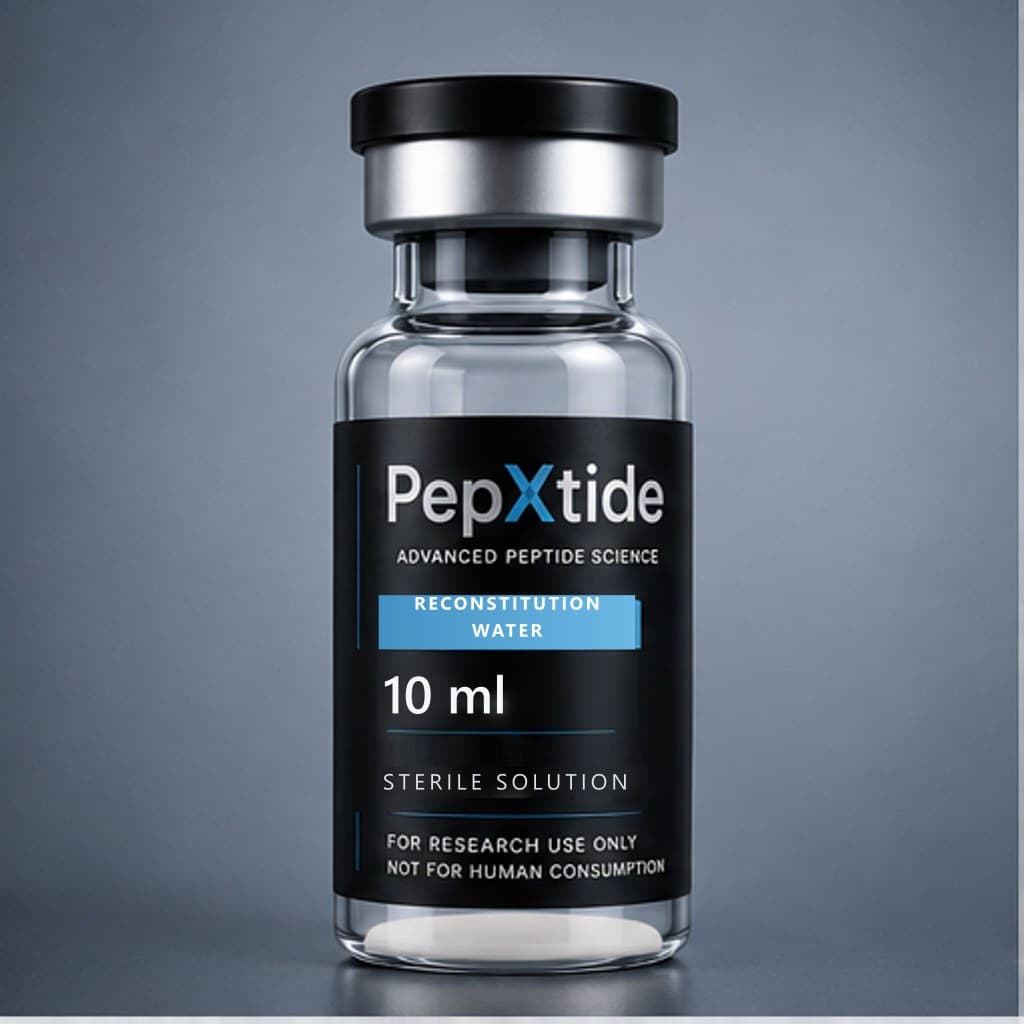
Research notice
Supplied as a lyophilized powder for in-vitro laboratory research only. No statement on this page describes an application, benefit, dose, route or outcome. Descriptions are structural and mechanistic, and reference data such as CAS numbers and molecular formulas is published information about the compound itself, provided for identification. No measured result is shown for this strength because a certificate has not yet been published for its lot.