

Research use only. This compound is supplied for in-vitro laboratory research by qualified researchers. It is not for human or veterinary consumption and has not been evaluated by the FDA.
Neuro Research
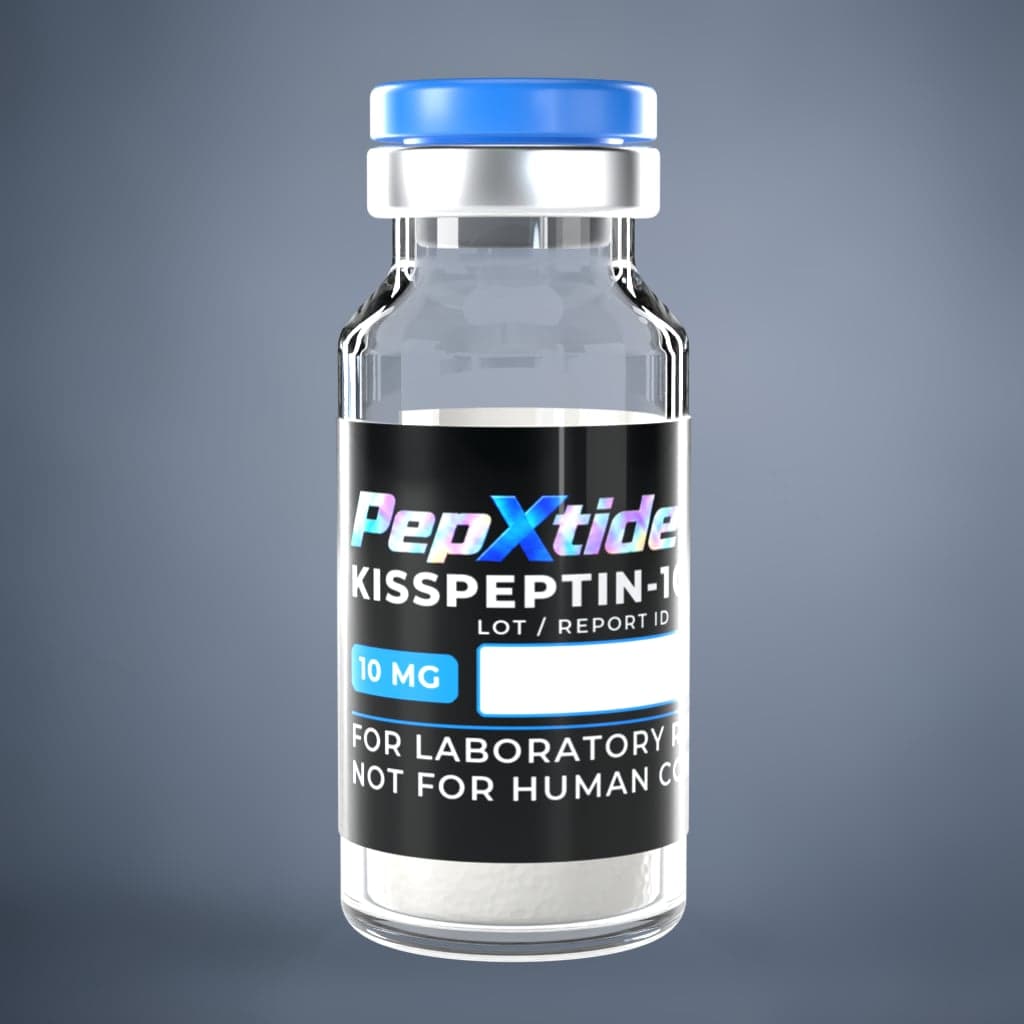
Kisspeptin-10
Certificate published · 10mg
10mg$59.99each
$6.00/mg
Laboratory report for the 10mg vial · Laboratory ID V260204-18-009
Vanguard Laboratory · Reported Feb 19, 2026
- Lot Number
- K26C457
- Method
- HPLC-UV/VIS
- Laboratory
- Vanguard Laboratory
- Chromatographic Purity result
- 99.70% ± 0.18%
Ordering at volume or on a schedule?
Request a supply quote →Buy more of this strength and the price comes down. The store applies it at checkout - there is nothing to enter.
Free US shipping - no minimum
Tell us the Report ID or Laboratory ID shown on the certificate, and what you observed. If independent testing shows a discrepancy against our published certificate, we refund the lot in full and pull it from sale pending investigation.
Tell us the Report ID or Laboratory ID shown on the certificate, and what you observed. If independent testing shows a discrepancy against our published certificate, we refund the lot in full and pull it from sale pending investigation.
Certificate published
Discreet packaging
Dispatched within one business day
Free US shipping, no minimum
In stock, ships from our US fulfilment partner
Compound information
- Type
- Neuro Research
- Molecular weight
- 1302.46 g/mol
- Sequence
- Tyr-Asn-Trp-Asn-Ser-Phe-Gly-Leu-Arg-Phe-NH2
- Form
- Lyophilized powder
- Vial strength
- 10mg
- Catalogue number
- PX-KISS10-10MG
- Purity
- See the laboratory report V260204-18-009
Identifiers are published properties of the molecule. Values we cannot confirm are omitted rather than estimated.
The ten-residue C-terminal fragment of kisspeptin, the product of the KISS1 gene, with an amidated C-terminus. Drawn in the PepXtide structural library, where its computed mass matches the published molecular weight.
The gene it comes from was identified in 1996 as a metastasis-suppressor gene in melanoma, and was named in Hershey, Pennsylvania, which is where the unusual spelling comes from. The gene product is processed to several peptides of different lengths sharing a common C-terminus, of which this decapeptide is the shortest that still activates the receptor, corresponding to residues 112 to 121 of the precursor. The receptor was deorphanised in 2001 by three independent groups in the same year, which is why it carries three names in the older literature.
The C-terminal amide is not decorative. This peptide belongs to the RFamide family, defined by an amidated arginine-phenylalanine C-terminus, and alanine-scanning work shows that phenylalanine 6, arginine 9 and phenylalanine 10 are critical and that alteration of the amidated C-terminus is not tolerated. A species note matters for cross-referencing: the human peptide ends in arginine-phenylalanine amide, while the rat, mouse, zebrafish and Xenopus orthologues end in arginine-tyrosine amide, so a rodent sequence is not interchangeable with this one.
The molecular target is KISS1R, also called GPR54, a 398-residue G-protein-coupled receptor that couples predominantly through Gq/11 to phospholipase C, inositol trisphosphate and intracellular calcium, with reported downstream protein kinase C, ERK1/2 and PI3K-Akt signalling. Reported affinities in CHO-K1 cells expressing the human receptor are in the low nanomolar range, with calcium-mobilisation half-maximal concentrations around one to four nanomolar, although at least one study using rat receptor in the same cell background reports values an order of magnitude weaker; a quoted number should always carry its assay system.
Selectivity is not absolute, and this is a useful design caution. The peptide has been reported to bind and activate the neuropeptide FF receptors NPFFR1 and NPFFR2 with appreciable potency, and the cross-reactivity is one-directional, so an experiment in a preparation expressing those receptors cannot attribute a response to KISS1R without a selective antagonist or knockdown control.
Its stability profile is specific and well documented. Matrix metalloproteinases 2 and 9 and several membrane-type metalloproteinases cleave the glycine-leucine bond at positions 7 and 8 of the decapeptide, abolishing activity, and the intact peptide has been reported completely digested within an hour in murine serum; non-hydrolysable isosteres of that bond were designed specifically to confer serum stability. Published preparation practice is dissolution in ultrapure water to a stock and dilution into buffer immediately before use, with identity confirmed by reversed-phase HPLC and electrospray mass spectrometry after Fmoc solid-phase synthesis.
Background
Kisspeptin-10 is the amidated C-terminal decapeptide of the KISS1 gene product (residues 112 to 121 of the precursor), the shortest fragment that still activates the receptor. It belongs to the RFamide family, and alanine scanning identifies Phe6, Arg9 and the amidated Phe10 as critical. Its target is KISS1R (GPR54), a GPCR coupling mainly through Gq/11 to phospholipase C and calcium, and it also cross-reacts with the neuropeptide FF receptors NPFFR1 and NPFFR2.
Research applications
Where this compound appears in the published literature. Each area points to the papers listed under Primary literature below. These describe what was studied, not an application of this product.
Neuronal cell models
Studied in SH-SY5Y-derived neuronal cells exposed to alpha-synuclein, in 2022 and 2023 International Journal of Molecular Sciences papers, the later one examining a receptor-independent route.[4][2]
Chondrocyte models
Investigated in a 2025 cultured-chondrocyte model of TNF-alpha-induced senescence examining SIRT1/p53/p21 signalling.[1]
Specifications
- Supplied as
- Lyophilized powder
- Available strengths
- 10mg
- Storage
- Store lyophilized at -20C, protected from light and moisture.
- Intended use
- In-vitro laboratory research only
Research overview
C-terminal decapeptide of kisspeptin
Ten residues, the shortest fragment that retains activity at its receptor. The C-terminal amide is required; the free acid is inactive, which is why it is modelled with the amide cap.
- Residues
- 10
- Atoms
- 94
Primary literature
Peer-reviewed papers indexed on PubMed that study this compound. We did not write them and we do not summarise them — each reference opens the record on PubMed so you can read the work itself. Publication is not evidence of safety or efficacy, and none of this research was conducted by PepXtide.
- J Biochem Mol Toxicol, 2025 · PMID 40400312
- Int J Mol Sci, 2023 · PMID 37047030
- Biomolecules, 2025 · PMID 41301510
- Int J Mol Sci, 2022 · PMID 35563582
- Brain Res, 2014 · PMID 25130664
Search the databases
The list above is a selection, not the whole literature. These open the public databases themselves, each one confirmed to return results on 29 August 2026.
PubMed, PubChem and ClinicalTrials.gov are independent scientific databases. A record or a published paper is not an endorsement of this product, and nothing indexed there describes an application, dose or outcome supported by PepXtide.
Storage & handling
Lyophilized
Store lyophilized at -20C, protected from light and moisture. The documented degradation route is metalloproteinase cleavage of the glycine-leucine bond, with complete digestion reported within an hour in serum, so prepare working dilutions immediately before use rather than holding them in protein-containing media.
Reconstituted
Once reconstituted, refrigerate at 2-8C and use within the period appropriate to the material.
Handling notes
- Store the lyophilized material at -20C, protected from light and moisture.
- The documented degradation route is metalloproteinase cleavage of the Gly7-Leu8 bond, with complete digestion reported within an hour in serum.
- Prepare working dilutions immediately before use rather than holding them in protein-containing media.
- Once reconstituted, refrigerate at 2-8C and use within the period appropriate to the material.
Safety & handling
Bench handling, not a dosing guide.
Intended use
Supplied strictly as a laboratory research material for in-vitro study by qualified researchers. Not for human or veterinary use, not for ingestion or injection, and not for any clinical or diagnostic application.
Personal protective equipment
Handle with gloves, eye protection and a laboratory coat. Weigh and transfer lyophilized powder in a ventilated enclosure to avoid generating an inhalable dust.
Reconstitution
Reconstitute against the diluent and volume appropriate to your protocol, adding solvent slowly down the vial wall rather than directly onto the pellet. Do not shake. This is a handling note, not a dosing guide.
Storage after opening
Once reconstituted, refrigerate and use within the period appropriate to the material. Avoid repeated freeze-thaw cycles, which degrade peptides faster than continuous storage at the listed temperature.
Disposal
Dispose of material and containers in accordance with your institution's chemical waste procedures and applicable local regulations.
Related compounds
Research notice
Supplied for in-vitro laboratory research only. Not for human or veterinary consumption, and not evaluated by the FDA. No statement on this page describes an application, benefit, dose, route or outcome. Descriptions are structural and mechanistic, and reference data such as CAS numbers and molecular formulas is published information about the compound itself, provided for identification. The certificate shown above is the testing laboratory's report V260204-18-009 for this strength; its results are for that report only and are not averaged across the product line.