

Research use only. This compound is supplied for in-vitro laboratory research by qualified researchers. It is not for human or veterinary consumption and has not been evaluated by the FDA.

Nasal Sprays
N-Acetyl Semax Amidate Nasal Solution
Certificate pending · 30mg
30mg$130.00each
$4.33/mg
This is N-Acetyl Semax Amidate supplied as a buffered, preserved aqueous solution rather than as a lyophilized cake. The peptide is the same molecule described on the powder product page; the formulation around it is what differs.
The peptide is the heptapeptide Semax - Met-Glu-His-Phe-Pro-Gly-Pro, corticotropin residues 4 to 7 extended with Pro-Gly-Pro - acetylated on the alpha-amino group of Met1 and amidated at Pro7, with the glutamate side chain left free. Both modifications are read off the deposited structure at PubChem CID 172638603. No CAS number is printed: the number in circulation appears only on supplier deposits, and FDA GSRS holds no record of the compound.
The corresponding free acid is registered separately, about one dalton heavier, and is the neighbour most easily mistaken for this compound on a specification table; the two separate cleanly by accurate mass. Removing both terminal charges makes this form measurably less hydrophilic than base Semax and it retains longer on a reversed-phase column, which is a useful identity check in its own right.
Methionine at position 1 is the residue that governs handling, and in a solution it governs shelf life. The sulfur is not chemically passive: in the copper complex characterised by Magri and colleagues, it makes a weak apical contact with the metal, and the acetylated peptide's complex carries a more positive formal redox potential than the free-amine peptide's and reacts with ascorbic acid where the other does not. There is no cysteine, and no tryptophan or tyrosine, so absorbance at 280 nm is not a valid concentration method here.
No molecular target is established for this compound or for base Semax. Neither appears in ChEMBL, and melanocortin-receptor activity is structurally unsupported rather than merely untested: the corticotropin pharmacophore His-Phe-Arg-Trp is incomplete in this sequence, because the arginine and tryptophan are precisely the residues that Pro-Gly-Pro replaced.
The acetyl group exists because of a measured cleavage. Shevchenko and colleagues reported in 2013 that digestion of base Semax by leucine aminopeptidase and by enzymes of nasal mucus, brain microsomal fraction and blood yields one detected metabolite, His-Phe-Pro-Gly-Pro, the peptide with its N-terminal Met-Glu removed. Pro-Gly-Pro already resists attack from the C-terminal end; acetylation closes the end the enzymes actually use.
A word on what is in the solution, since that is what separates this product from the powder. Beyond peptide and water there are three components. A tonicity agent - sodium chloride in some marketed products, a polyol or sugar such as sorbitol or dextrose in others - sets the osmolality, and that choice is chemistry rather than cosmetics, because a salt contributes ionic strength that screens charge and shifts apparent side-chain acidity while a polyol contributes none and additionally stabilises the compact state by preferential exclusion from the hydration shell. A buffer - citrate, acetate, succinate or citrate-phosphate systems, in the range roughly pH 4.5 to 6.8 across marketed nasal solutions - holds the pH near the minimum of the degradation rate, since backbone hydrolysis is acid-catalysed and deamidation is base-catalysed and the two do not share an optimum; unbuffered, the pH would drift as dissolved carbon dioxide and container leachables accumulate over shelf life. And a preservative, usually benzalkonium chloride at roughly one to two parts in ten thousand, a quaternary ammonium surfactant whose permanently charged head adsorbs to the anionic microbial envelope and whose alkyl tail partitions into the bilayer and destroys its permeability barrier - necessary because a near-neutral aqueous solution holding a peptide and a sugar is a growth medium and a container that is opened more than once meets the organisms in the air around it. A chelating agent such as disodium edetate is frequently present as a fourth, and for this peptide it is the component that matters most, since it sequesters the copper the methionine would otherwise coordinate.
Certificate pending for the 30mg lot.The signed report will be published here as soon as the laboratory returns it.
Ordering at volume or on a schedule?
Request a supply quote →Buy more of this strength and the price comes down. The store applies it at checkout - there is nothing to enter.
Free US shipping - no minimum
Tell us the lot number and what you observed. If independent testing shows a discrepancy against our published certificate, we refund the lot in full and pull it from sale pending investigation.
Tell us the lot number and what you observed. If independent testing shows a discrepancy against our published certificate, we refund the lot in full and pull it from sale pending investigation.
Certificate pending
Discreet packaging
Dispatched within one business day
Free US shipping, no minimum
Compound information
- Type
- Nasal Sprays
- Molecular formula
- C39H54N10O10S
- Molecular weight
- 855.0 g/mol
- Sequence
- Ac-Met-Glu-His-Phe-Pro-Gly-Pro-NH2 (acetyl-MEHFPGP-amide)
- Form
- Preserved aqueous solution
- Vial strength
- 30mg
- Catalogue number
- PX-NASEMAXNASAL-30MG
- Purity
- Certificate pending for this strength
Identifiers are published properties of the molecule. Values we cannot confirm are omitted rather than estimated.
Storage & handling
Lyophilized
Refrigerate at 2-8C and protect from light. Being a solution rather than a cake, this form has no dormant period: Met1 oxidation to the sulfoxide is running from the day it is filled. Magri and colleagues showed in 2016 that the copper complex of the acetylated peptide is redox-active in a way the free-amine peptide's is not, reacting with ascorbic acid, which makes a chelating agent in the formulation load-bearing rather than incidental here. Keep the container closed and full where practical, since headspace oxygen feeds the same route..
Reconstituted
Refrigerate after reconstitution and use within the period appropriate to the material.
Safety & handling
Bench handling, not a dosing guide.
Intended use
Supplied strictly as a laboratory research material for in-vitro study by qualified researchers. Not for human or veterinary use, not for ingestion or injection, and not for any clinical or diagnostic application.
Personal protective equipment
Handle with gloves, eye protection and a laboratory coat. Weigh and transfer lyophilized powder in a ventilated enclosure to avoid generating an inhalable dust.
Reconstitution
Reconstitute against the diluent and volume appropriate to your protocol, adding solvent slowly down the vial wall rather than directly onto the pellet. Do not shake. This is a handling note, not a dosing guide.
Storage after opening
Once reconstituted, refrigerate and use within the period appropriate to the material. Avoid repeated freeze-thaw cycles, which degrade peptides faster than continuous storage at the listed temperature.
Disposal
Dispose of material and containers in accordance with your institution's chemical waste procedures and applicable local regulations.
Related compounds
Neuro Research
N-Acetyl Semax Amidate
Lyophilized powder
Nasal Sprays
Kisspeptin-10 Nasal Solution
Preserved aqueous solution
Neuro Research
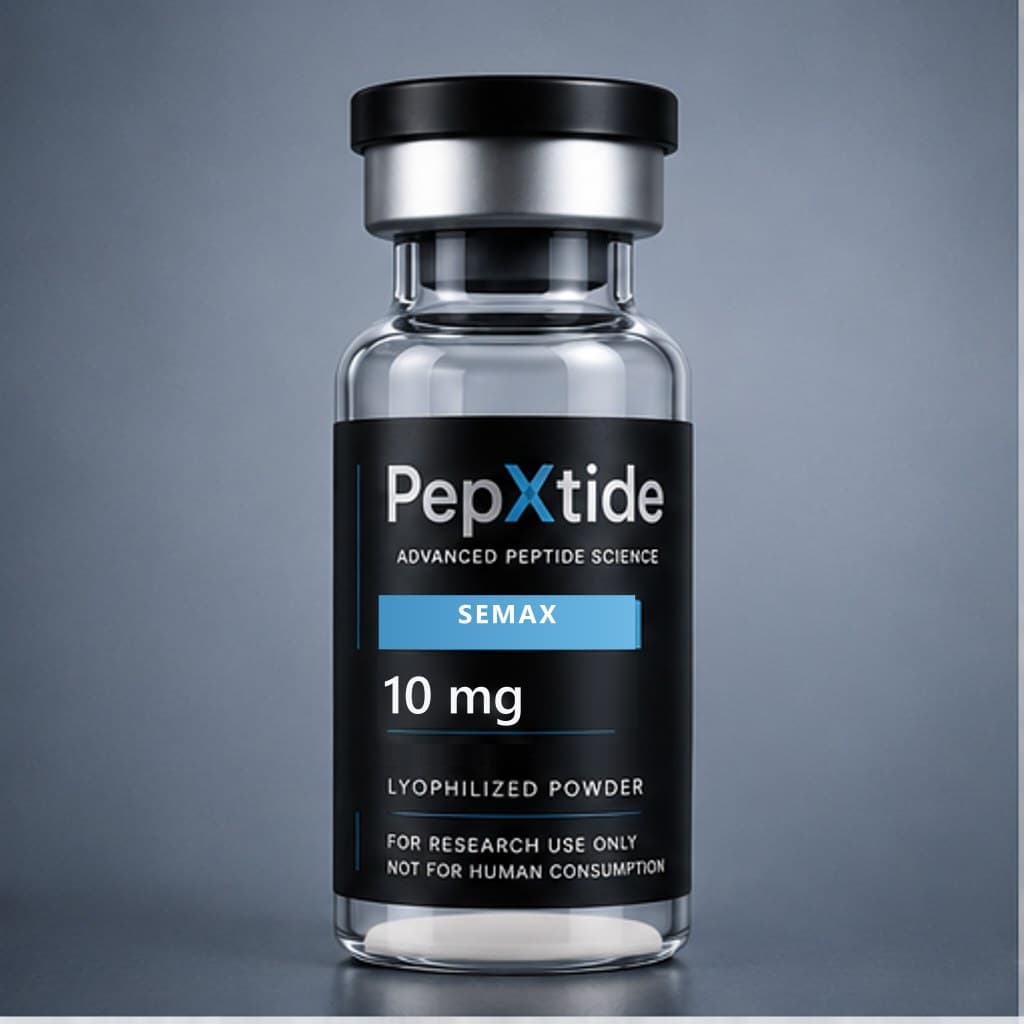
Semax
Lyophilized powder
Neuro Research
N-Acetyl Selank
Lyophilized powder
Research notice
Supplied for in-vitro laboratory research only. Not for human or veterinary consumption, and not evaluated by the FDA. No statement on this page describes an application, benefit, dose, route or outcome. Descriptions are structural and mechanistic, and reference data such as CAS numbers and molecular formulas is published information about the compound itself, provided for identification. No measured result is shown for this strength because a certificate has not yet been published for its lot.