

Research use only. This compound is supplied for in-vitro laboratory research by qualified researchers. It is not for human or veterinary consumption and has not been evaluated by the FDA.

Nasal Sprays
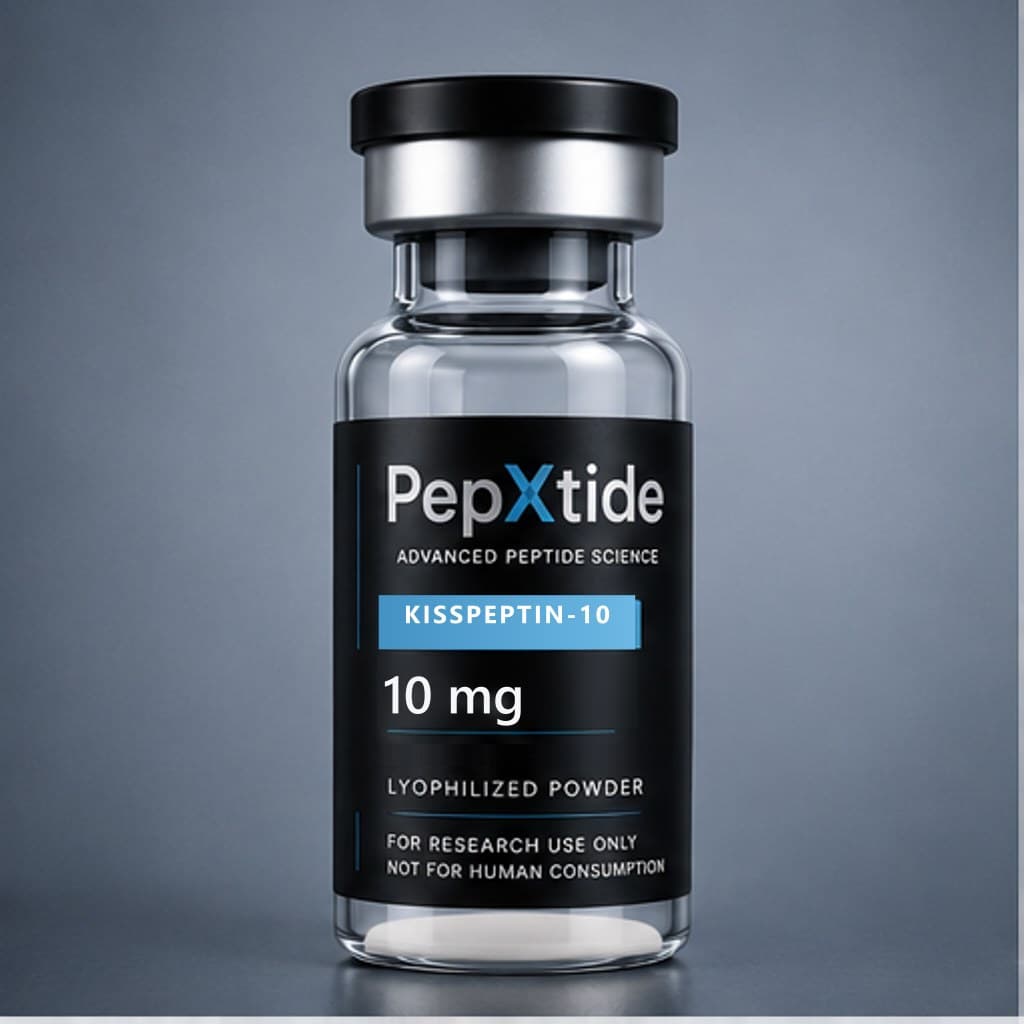
Kisspeptin-10 Nasal Solution
Certificate pending · 10mg
10mg$125.00each
$12.50/mg
This is Kisspeptin-10 supplied as a buffered, preserved aqueous solution rather than as a lyophilized cake. The peptide itself is the same molecule described on the Kisspeptin-10 product page; what differs is the formulation around it.
Kisspeptin-10 is the C-terminal decapeptide of the KISS1 gene product, annotated on UniProt Q15726 as residues 112 to 121 of the precursor, which is also why the literature calls it metastin 45-54. The same annotation marks that decapeptide as the region essential for receptor binding and activation. Its receptor is KISS1R (UniProt Q969F8), a class A G-protein-coupled receptor also published under the names GPR54, AXOR12 and OT7T175 - four names, one accession.
The C-terminal amide is part of the identity rather than a finishing detail: it is the RFamide motif that defines this ligand family, recorded by UniProt as a phenylalanine amide at residue 121 and by FDA GSRS as a registered phenylalanylamide modification at position 10. Ohtaki and colleagues reported the amidation in the Nature paper that identified the peptide in 2001.
That makes the des-amido form the impurity that matters, and it is only about one dalton away. Worse, the arginine-9 citrulline analogue has the identical formula and the identical monoisotopic mass to that des-amido species, so accurate mass alone cannot separate the two - confirmation needs fragmentation or sequencing. The same one-dalton shift also arises from deamidation at either asparagine, which means a single mass reading has three plausible explanations and distinguishes none of them.
The peptide has one tryptophan, one tyrosine and two phenylalanines, so unlike most of the short peptides in this catalogue it has a genuine chromophore and absorbance at 280 nm is a usable concentration method. It contains no cysteine and no methionine; Trp3 is the oxidation-prone residue instead.
One documented cleavage route runs inside the decapeptide rather than at an end. UniProt Q15726 records matrix metalloproteinases 2 and 9 cutting between precursor residues 118 and 119, which are positions 7 and 8 of this peptide - the glycine-leucine bond. Tomita and colleagues confirmed it in the Journal of Medicinal Chemistry in 2008 by building alkene and hydroxyethylene isosteres of that one bond and measuring the resulting resistance. Separately, Liu and colleagues characterised the principal decomposition product in plasma as the peptide with its N-terminal tyrosine removed, using a validated mass-spectrometry assay.
A word on what is in the solution, since that is what makes this a different product from the powder. A nasal-grade peptide solution is three things beyond the peptide and water: a tonicity agent, a buffer and a preservative. The tonicity agent - sodium chloride in some marketed products, a polyol or sugar such as sorbitol or dextrose in others - sets the osmolality of the solution, and the choice is chemical rather than cosmetic, because a salt also contributes ionic strength that screens charge and shifts apparent side-chain acidity while a polyol contributes none and additionally stabilises the compact state of a peptide by preferential exclusion from its hydration shell. The buffer, typically a citrate, acetate, succinate or citrate-phosphate system in the pH range roughly 4.5 to 6.8, holds the pH near the minimum of the peptide's own degradation rate, since amide hydrolysis is acid-catalysed and asparagine deamidation is base-catalysed and each has a different pH optimum; without a buffer, dissolved carbon dioxide and leachables from the container would move the pH over shelf life. The preservative, usually benzalkonium chloride at roughly one to two parts in ten thousand, is a quaternary ammonium surfactant whose permanently charged head adsorbs to the anionic surface of a microbial envelope and whose alkyl tail then partitions into the bilayer and destroys its permeability barrier; it is present because a near-neutral aqueous solution containing a peptide and a sugar is itself a growth medium, and a container that is opened more than once meets the organisms in the air around it. A chelating agent such as disodium edetate is frequently the fourth component, sequestering the trace iron and copper that would otherwise drive the tryptophan oxidation described above.
Certificate pending for the 10mg lot.The signed report will be published here as soon as the laboratory returns it.
Ordering at volume or on a schedule?
Request a supply quote →Buy more of this strength and the price comes down. The store applies it at checkout - there is nothing to enter.
Free US shipping - no minimum
Tell us the lot number and what you observed. If independent testing shows a discrepancy against our published certificate, we refund the lot in full and pull it from sale pending investigation.
Tell us the lot number and what you observed. If independent testing shows a discrepancy against our published certificate, we refund the lot in full and pull it from sale pending investigation.
Certificate pending
Discreet packaging
Dispatched within one business day
Free US shipping, no minimum
Compound information
- Type
- Nasal Sprays
- CAS number
- 374675-21-5
- Molecular formula
- C63H83N17O14
- Molecular weight
- 1302.4 g/mol
- Sequence
- Tyr-Asn-Trp-Asn-Ser-Phe-Gly-Leu-Arg-Phe-NH2 (YNWNSFGLRF, C-terminally amidated)
- Form
- Preserved aqueous solution
- Vial strength
- 10mg
- Catalogue number
- PX-KISSNASAL-10MG
- Purity
- Certificate pending for this strength
Identifiers are published properties of the molecule. Values we cannot confirm are omitted rather than estimated.
Storage & handling
Lyophilized
Refrigerate at 2-8C and protect from light. This is a solution rather than a cake, so every route below is already running from the day it is filled and the working period is shorter than for the lyophilized form of the same compound. Trp3 is photolabile and oxidises to oxindole and kynurenine species sixteen and thirty-two daltons heavier, which is why the container is kept dark and why a chelating agent is usually present to sequester the trace iron and copper that catalyse it. The two asparagines deamidate by a base-catalysed route, so the formulation is held below neutral pH rather than at it..
Reconstituted
Refrigerate after reconstitution and use within the period appropriate to the material.
Safety & handling
Bench handling, not a dosing guide.
Intended use
Supplied strictly as a laboratory research material for in-vitro study by qualified researchers. Not for human or veterinary use, not for ingestion or injection, and not for any clinical or diagnostic application.
Personal protective equipment
Handle with gloves, eye protection and a laboratory coat. Weigh and transfer lyophilized powder in a ventilated enclosure to avoid generating an inhalable dust.
Reconstitution
Reconstitute against the diluent and volume appropriate to your protocol, adding solvent slowly down the vial wall rather than directly onto the pellet. Do not shake. This is a handling note, not a dosing guide.
Storage after opening
Once reconstituted, refrigerate and use within the period appropriate to the material. Avoid repeated freeze-thaw cycles, which degrade peptides faster than continuous storage at the listed temperature.
Disposal
Dispose of material and containers in accordance with your institution's chemical waste procedures and applicable local regulations.
Related compounds
Research notice
Supplied for in-vitro laboratory research only. Not for human or veterinary consumption, and not evaluated by the FDA. No statement on this page describes an application, benefit, dose, route or outcome. Descriptions are structural and mechanistic, and reference data such as CAS numbers and molecular formulas is published information about the compound itself, provided for identification. No measured result is shown for this strength because a certificate has not yet been published for its lot.