

Research use only. This compound is supplied for in-vitro laboratory research by qualified researchers. It is not for human or veterinary consumption and has not been evaluated by the FDA.
Metabolic Research
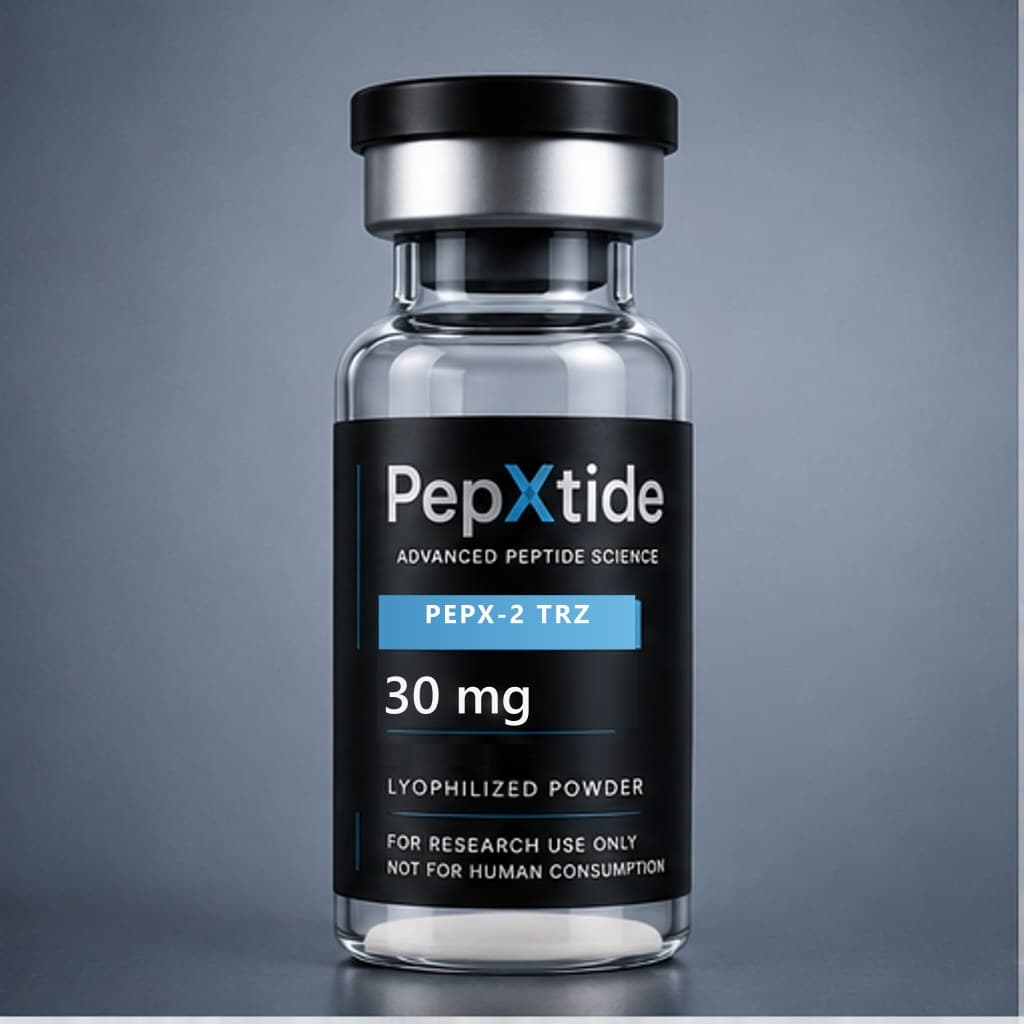
GLP-2 (Tirzepatide) 30mg
Certificate pending · 30mg
30mg$149.99each
$5.00/mg
GLP-2 (Tirzepatide) is a 39-residue lipopeptide studied as a dual agonist at the GIP and GLP-1 receptors. It carries alpha-aminoisobutyric acid at positions 2 and 13, a C-terminal amide, and a C20 fatty diacid on Lys20 attached through a linker.
No molecular weight is printed on this page. The published figure includes the fatty diacid and its linker, neither of which the structural engine draws, so the mass the viewer would compute is the peptide backbone alone; publishing a number that disagrees with the model shown beside it would be worse than publishing none.
The backbone is a GIP sequence, not a GLP-1 one, which is the opposite of what the compound's receptor profile might suggest. The originating work at Eli Lilly, published in 2018, describes the molecule as having been made by engineering GLP-1 activity into the GIP sequence, and that lineage is the reason the compound is not simply a modified version of the earlier GLP-1 analogues.
Three modifications carry the chemistry. Alpha-aminoisobutyric acid at position two sits precisely at the dipeptidyl peptidase IV cleavage site and is what confers resistance to that enzyme; a second alpha-aminoisobutyric acid at position 13 adds further backbone constraint. The lysine at position 20 bears a C20 eicosanedioic diacid attached through a gamma-glutamate and two oligoethylene-glycol spacer units, and that diacid is the albumin-binding element. The C-terminus is a serine amide.
The receptor pharmacology is well quantified. Reported binding affinities in HEK293 cells expressing each human receptor are about 0.135 nanomolar at the GIP receptor against about 4.23 nanomolar at the GLP-1 receptor, with cyclic AMP half-maximal concentrations of roughly 0.022 and 0.934 nanomolar respectively. Both are class B1 G-protein-coupled receptors.
A more interesting in-vitro property is signalling bias, reported in 2020. At the GLP-1 receptor the compound behaves as a partial agonist for beta-arrestin recruitment, under a tenth of the maximal response to GLP-1, with receptor internalisation under 40 percent of the GLP-1 maximum, while at the GIP receptor arrestin recruitment and internalisation resemble those of native GIP. The compound is therefore biased toward cyclic AMP signalling over arrestin recruitment at one of its two receptors but not the other. Assay systems for that work are HEK293 lines at defined receptor densities, CHO-K1 enzyme-fragment-complementation lines for arrestin, and bioluminescence resonance energy transfer for internalisation. Cryo-electron microscopy structures of the compound bound to both receptors in complex with Gs have been deposited in the Protein Data Bank.
Certificate pending for the 30mg lot.The signed report will be published here as soon as the laboratory returns it.
Ordering at volume or on a schedule?
Request a supply quote →Buy more of this strength and the price comes down. The store applies it at checkout - there is nothing to enter.
Free US shipping - no minimum
Tell us the lot number and what you observed. If independent testing shows a discrepancy against our published certificate, we refund the lot in full and pull it from sale pending investigation.
Tell us the lot number and what you observed. If independent testing shows a discrepancy against our published certificate, we refund the lot in full and pull it from sale pending investigation.
Certificate pending
Discreet packaging
Dispatched within one business day
Free US shipping, no minimum
Compound information
- Type
- Metabolic Research
- Sequence
- 39 residues with Aib at positions 2 and 13, C-terminal amide, C20 fatty diacid on Lys20
- Form
- Lyophilized powder
- Vial strength
- 30mg
- Catalogue number
- PX-2TRZ-30MG
- Purity
- Certificate pending for this strength
Identifiers are published properties of the molecule. Values we cannot confirm are omitted rather than estimated.
Background
GLP-2 (Tirzepatide) is a 39-residue lipopeptide built on a GIP backbone into which GLP-1 activity was engineered, originating from Eli Lilly work published in 2018. Aib at position 2 sits at the DPP-IV cleavage site and a second Aib at 13 adds backbone constraint, while Lys20 carries a C20 eicosanedioic diacid through a gamma-glutamate and two oligoethylene-glycol spacers as an albumin-binding element. It is a dual agonist at the GIP and GLP-1 receptors, both class B1 GPCRs, with a serine amide C-terminus.
Research applications
Where this compound appears in the published literature. Each area points to the papers listed under Primary literature below. These describe what was studied, not an application of this product.
Specifications
- Supplied as
- Lyophilized powder
- Available strengths
- 30mg
- Storage
- Store lyophilized at -20C, protected from light and moisture.
- Intended use
- In-vitro laboratory research only
Primary literature
Peer-reviewed papers indexed on PubMed that study this compound. We did not write them and we do not summarise them — each title opens the record on PubMed so you can read the work itself. Publication is not evidence of safety or efficacy, and none of this research was conducted by PepXtide.
- Tirzepatide is an imbalanced and biased dual GIP and GLP-1 receptor agonistJCI Insight, 2020 · PMID 32730231
- Tirzepatide, GIP(1-42) and GIP(1-30) display unique signaling profiles at two common GIP receptor variants, E354 and Q354Front Pharmacol, 2024 · PMID 39464637
PubMed, PubChem and ClinicalTrials.gov are independent scientific databases. A record or a published paper is not an endorsement of this product, and nothing indexed there describes an application, dose or outcome supported by PepXtide.
Storage & handling
Lyophilized
Store lyophilized at -20C, protected from light and moisture. The molecule is amphiphilic because of its C20 diacid tail, so it will adsorb to surfaces and can aggregate at interfaces; low-binding vessels and minimal agitation are worth using, and solutions should be protected from light and air because of the tryptophan in the chain.
Reconstituted
Once reconstituted, keep refrigerated and use within the working period established by the laboratory.
Handling notes
- Store lyophilized at -20C, protected from light and moisture.
- The C20 diacid tail makes the molecule amphiphilic, so it adsorbs to surfaces and can aggregate at interfaces; use low-binding vessels and minimal agitation.
- Protect solutions from light and air because of the tryptophan in the chain.
- Once reconstituted, keep refrigerated and use within the working period established by the laboratory.
Safety & handling
Bench handling, not a dosing guide.
Intended use
Supplied strictly as a laboratory research material for in-vitro study by qualified researchers. Not for human or veterinary use, not for ingestion or injection, and not for any clinical or diagnostic application.
Personal protective equipment
Handle with gloves, eye protection and a laboratory coat. Weigh and transfer lyophilized powder in a ventilated enclosure to avoid generating an inhalable dust.
Reconstitution
Reconstitute against the diluent and volume appropriate to your protocol, adding solvent slowly down the vial wall rather than directly onto the pellet. Do not shake. This is a handling note, not a dosing guide.
Storage after opening
Once reconstituted, refrigerate and use within the period appropriate to the material. Avoid repeated freeze-thaw cycles, which degrade peptides faster than continuous storage at the listed temperature.
Disposal
Dispose of material and containers in accordance with your institution's chemical waste procedures and applicable local regulations.
Related compounds

Metabolic Research
GLP-2 (Tirzepatide) 10mg
Lyophilized powder
Metabolic Research
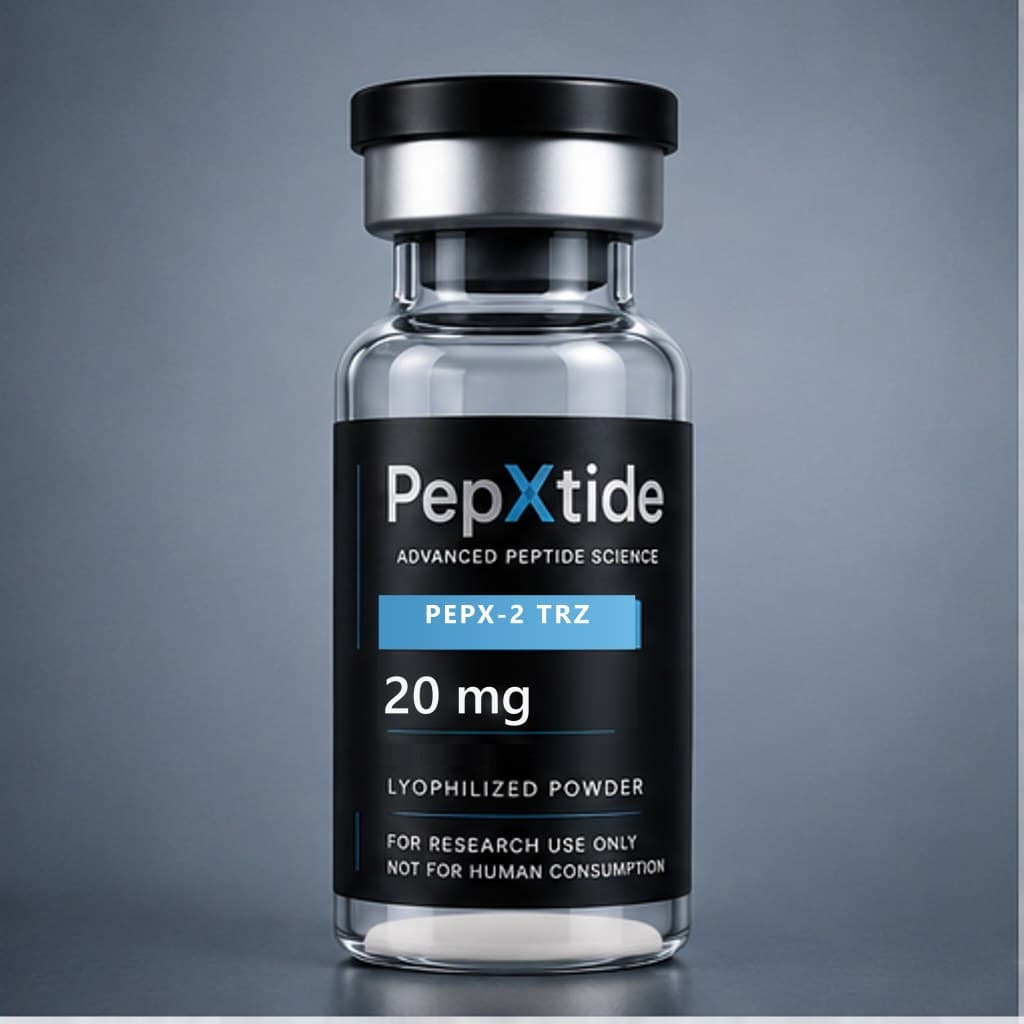
GLP-2 (Tirzepatide) 20mg
Lyophilized powder
Metabolic Research
GLP-2 (Tirzepatide) 60mg
Lyophilized powder
Metabolic Research
5-Amino-1MQ
Lyophilized powder
Research notice
Supplied as a lyophilized powder for in-vitro laboratory research only. Not for human or veterinary consumption, and not approved by the FDA for any use. No statement on this page describes an application, benefit, dose, route or outcome. Descriptions are structural and mechanistic, and reference data such as CAS numbers and molecular formulas is published information about the compound itself, provided for identification. No measured result is shown for this strength because a certificate has not yet been published for its lot.