

New to research peptides? Start here.
Buying research compounds comes with paperwork: certificates, lot numbers, purity figures. This page explains each piece in plain words, so the documents behind a vial make sense from the first read.
Each vial's lab report status is on its product page. Published reports are listed in the certificate library.
Part 1
What a certificate (COA) shows, and how to read one
A certificate of analysis, or COA, is the lab's own report for one production lot. It records what the material was tested for, the method used, and what the lab found. It applies to that lot only.
Simplified diagram, not a real report
Certificate of analysis
Laboratory name
Report ID
The lab's own ID
| Compound | Compound name and strength |
|---|---|
| Identity | Checked against a reference standard, where the report has this row |
| Method | Instrument and detector used |
| Purity | Measured figure ± margin of error |
| Quantity | Amount the lab found in the vial |
| Date | Date the lab issued the result |
Try it on a real report
Open a report in the certificate library and find the numbered items it carries. Not every report has an identity row.
Open the certificate libraryIdentity: is it the right compound?
The lab compares the lot with a reference standard, a known sample of the compound. Where the report has this row, the certificate records it as a pass. Not every report has it, so read the certificate rather than assuming it.
Lot match: is it this vial?
The Report ID or Laboratory ID ties the report to one lot. Check that the compound and strength on the report match the product page for the vial you are looking at.
Purity and method: how it was measured
The method is printed beside the figure. HPLC separates a sample into its parts. MS (mass spectrometry) confirms what a part is by its mass.
Quantity: how much is in the vial
A separate row for the amount the lab found, so the label can be checked against a measured number.
Laboratory: who tested it
An independent third-party lab, named on the report itself. We do not test our own material.
Date: when it was tested
A report describes the lot on the day it was tested. An old date on a recently shipped vial is worth asking about.
Part 2
What “purity” means, in plain words
Purity is the share of the material that is the compound named on the label, as the lab's instrument sees it. Think of it as one slice of a pie: the bigger the main slice, the less of anything else.
On a report it is a single figure with a small margin of error. Each certificate carries the figure the lab measured for that lot, high or low.
- Tall main peak = the compound
- Small peaks = anything else
- Left to right = time on the instrument
A share, not an amount
Purity tells you the proportion. How much is in the vial is the quantity row, measured separately.
One lot, one day
Two lots of the same compound are two different batches. A report on one says nothing about the other.
The method matters
The instrument only sees what it is set up to detect. That is why the method is printed next to the figure.
Labs are not a ranking
Two labs with different settings can return different figures for the same material. Compare like with like.
Part 3
How to read a PepXtide product page
Every product page is laid out the same way. Here is where each piece sits.
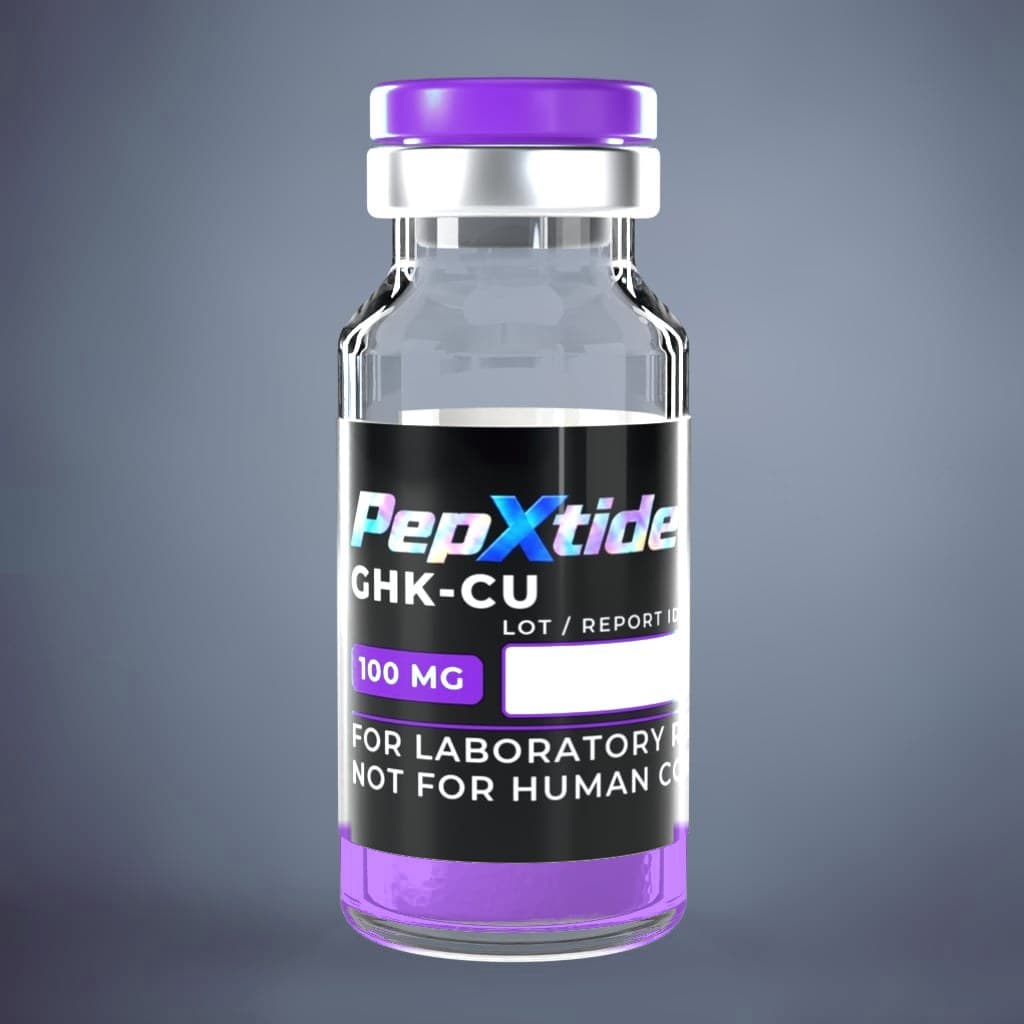
Matrix & Cytoskeletal · Lyophilized powder
GHK-Cu
Certificate published for the 100mg strength. The report opens from the product page.
Storage. Store lyophilized at -20C, protected from light and moisture.
Research use only. This compound is supplied for in-vitro laboratory research by qualified researchers.
Name and compound type
The compound name, its type group, and its form. Most are a freeze-dried powder.
Strength
Each strength shows its own lab report status and its own price. Pick a strength and the page updates.
Lab report status
Shows the report status for the strength you picked: Certificate published, Certificate for the lot shipping now, Lab report available on request, or Certificate pending.
Storage note
Where the page lists one. Conditions differ by compound, and the product page is the reference.
Research-use notice
On every product page.
Part 5
Research use only
Every PepXtide product is a laboratory research material. It is supplied for in-vitro study by qualified researchers. It is not for human or veterinary use, and not for any clinical or diagnostic application.
We can tell you what a compound is, its documentation, and how it behaves in handling and storage. We do not advise on use in a person.