

Research use only. This compound is supplied for in-vitro laboratory research by qualified researchers. It is not for human or veterinary consumption and has not been evaluated by the FDA.
Growth & Secretagogue
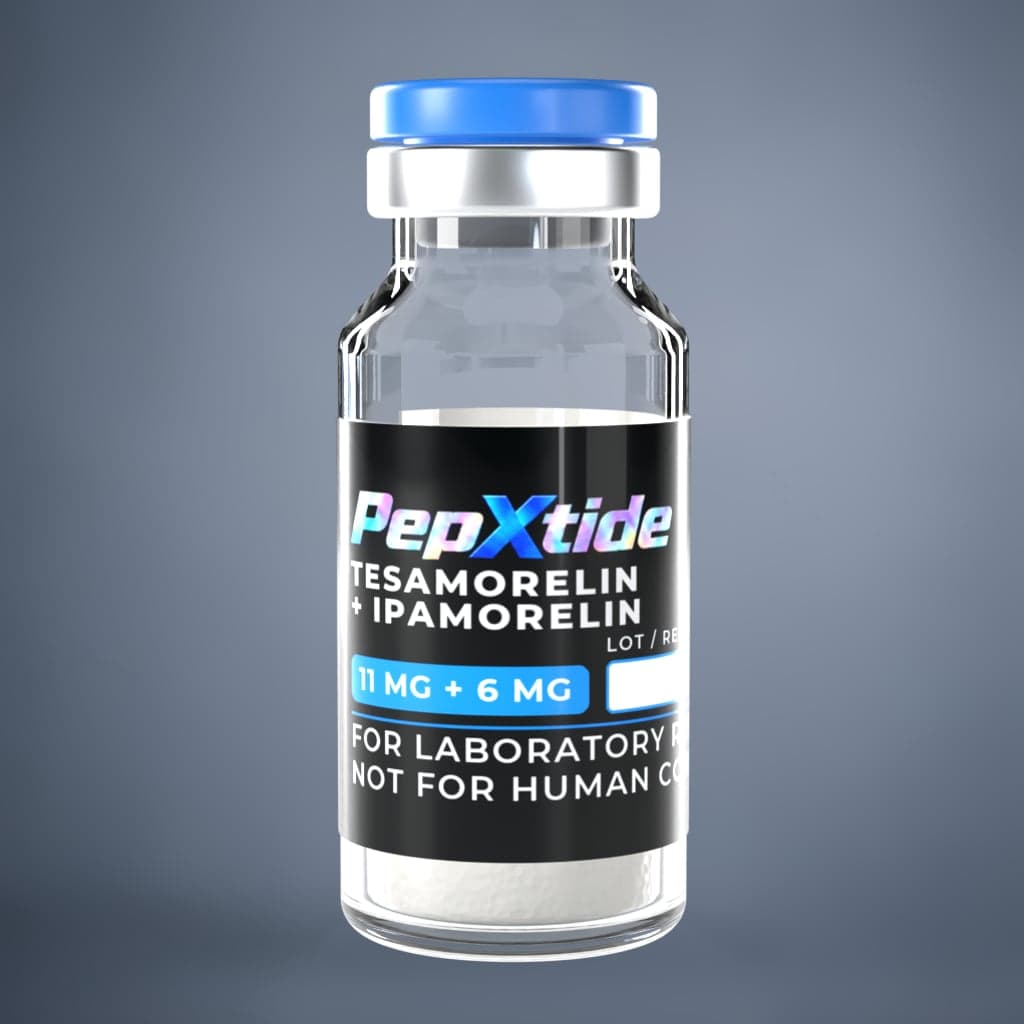
Tesamorelin + Ipamorelin
Certificate pending · 11mg + 6mg
11mg + 6mg$124.99each
Certificate pending for the 11mg + 6mg lot.The signed report will be published here as soon as the laboratory returns it.
Ordering at volume or on a schedule?
Request a supply quote →Buy more of this strength and the price comes down. The store applies it at checkout - there is nothing to enter.
Free US shipping - no minimum
Tell us the Report ID or Laboratory ID shown on the certificate, and what you observed. If independent testing shows a discrepancy against our published certificate, we refund the lot in full and pull it from sale pending investigation.
Tell us the Report ID or Laboratory ID shown on the certificate, and what you observed. If independent testing shows a discrepancy against our published certificate, we refund the lot in full and pull it from sale pending investigation.
Certificate pending
Discreet packaging
Dispatched within one business day
Free US shipping, no minimum
In stock, ships from our US fulfilment partner
Compound information
- Type
- Growth & Secretagogue
- Form
- Lyophilized powder blend
- Vial strength
- 11mg + 6mg
- Catalogue number
- PX-TESAIPA-11MG-6MG
- Purity
- Certificate pending for this strength
Identifiers are published properties of the molecule. Values we cannot confirm are omitted rather than estimated.
A blend of Tesamorelin (11mg) and Ipamorelin (6mg) in a single vial. Each component is described on its own product page.
As with the other pairing in this category, the two components act at different receptors in different G-protein-coupled receptor classes. Tesamorelin is the full 44-residue human releasing factor carrying a trans-3-hexenoyl cap on its N-terminal tyrosine, and acts at the GHRH receptor, a class B secretin-family receptor coupled to adenylyl cyclase. Ipamorelin is a five-residue compound of the growth-hormone-releasing-peptide chemotype and acts at the growth hormone secretagogue receptor type 1a, a class A rhodopsin-family receptor coupled through phospholipase C to calcium.
Their stabilising chemistry is also unrelated. The acyl cap on the 44-residue peptide exists to block dipeptidyl peptidase IV cleavage after the N-terminal tyrosine, a mechanism demonstrated in plasma-stability incubations. The pentapeptide instead resists peptidases through its non-proteinogenic first residue, its two D-configured aromatic residues and its C-terminal amide.
The size difference between the two is large, roughly 5,136 daltons against roughly 712, a factor of more than seven. That has a practical consequence for anyone characterising the vial: the two components will behave very differently in a separation and cannot be quantified against one another by any single-reading method.
No published study characterises the mixture as an entity, and the citations shown on this page are papers about the individual components. The label states a combined mass of 17mg (11mg + 6mg) across two compounds, so a per-milligram rate would not mean what a reader comparing it against a single compound would assume, and none is published.
Background
A single-vial blend of two unrelated secretagogues that act at receptors in different G-protein-coupled receptor classes. Tesamorelin is the 44-residue human releasing factor capped with a trans-3-hexenoyl group and acts at the class B GHRH receptor; Ipamorelin is a five-residue compound of the growth-hormone-releasing-peptide chemotype acting at the class A growth hormone secretagogue receptor type 1a. No published study characterises the mixture as an entity.
Specifications
- Supplied as
- Lyophilized powder blend
- Available strengths
- 11mg + 6mg
- Components
- Tesamorelin · Ipamorelin
- Storage
- Store lyophilized at -20C, protected from light and moisture.
- Intended use
- In-vitro laboratory research only
Storage & handling
Lyophilized
Store lyophilized at -20C, protected from light and moisture. The 44-residue component contains methionine and is the more chemically fragile of the two, so the blend should be protected from air and moisture on the tolerances of that component rather than the pentapeptide's.
Reconstituted
Once reconstituted, refrigerate at 2-8C and use within the period appropriate to the material.
Handling notes
- Store the lyophilized blend at -20C, protected from light and moisture.
- The 44-residue component contains methionine and is the more chemically fragile, so protect the blend from air and moisture on its tolerances.
- The two components differ in size by a factor of more than seven and cannot be quantified against one another by any single-reading method.
- Once reconstituted, refrigerate at 2-8C and use within the period appropriate to the material.
Safety & handling
Bench handling, not a dosing guide.
Intended use
Supplied strictly as a laboratory research material for in-vitro study by qualified researchers. Not for human or veterinary use, not for ingestion or injection, and not for any clinical or diagnostic application.
Personal protective equipment
Handle with gloves, eye protection and a laboratory coat. Weigh and transfer lyophilized powder in a ventilated enclosure to avoid generating an inhalable dust.
Reconstitution
Reconstitute against the diluent and volume appropriate to your protocol, adding solvent slowly down the vial wall rather than directly onto the pellet. Do not shake. This is a handling note, not a dosing guide.
Storage after opening
Once reconstituted, refrigerate and use within the period appropriate to the material. Avoid repeated freeze-thaw cycles, which degrade peptides faster than continuous storage at the listed temperature.
Disposal
Dispose of material and containers in accordance with your institution's chemical waste procedures and applicable local regulations.
Related compounds
Growth & Secretagogue
CJC-1295 without DAC
Lyophilized powder
Growth & Secretagogue
CJC-1295 without DAC + Ipamorelin
Lyophilized powder blend
Growth & Secretagogue
IGF-1 LR3
Lyophilized powder
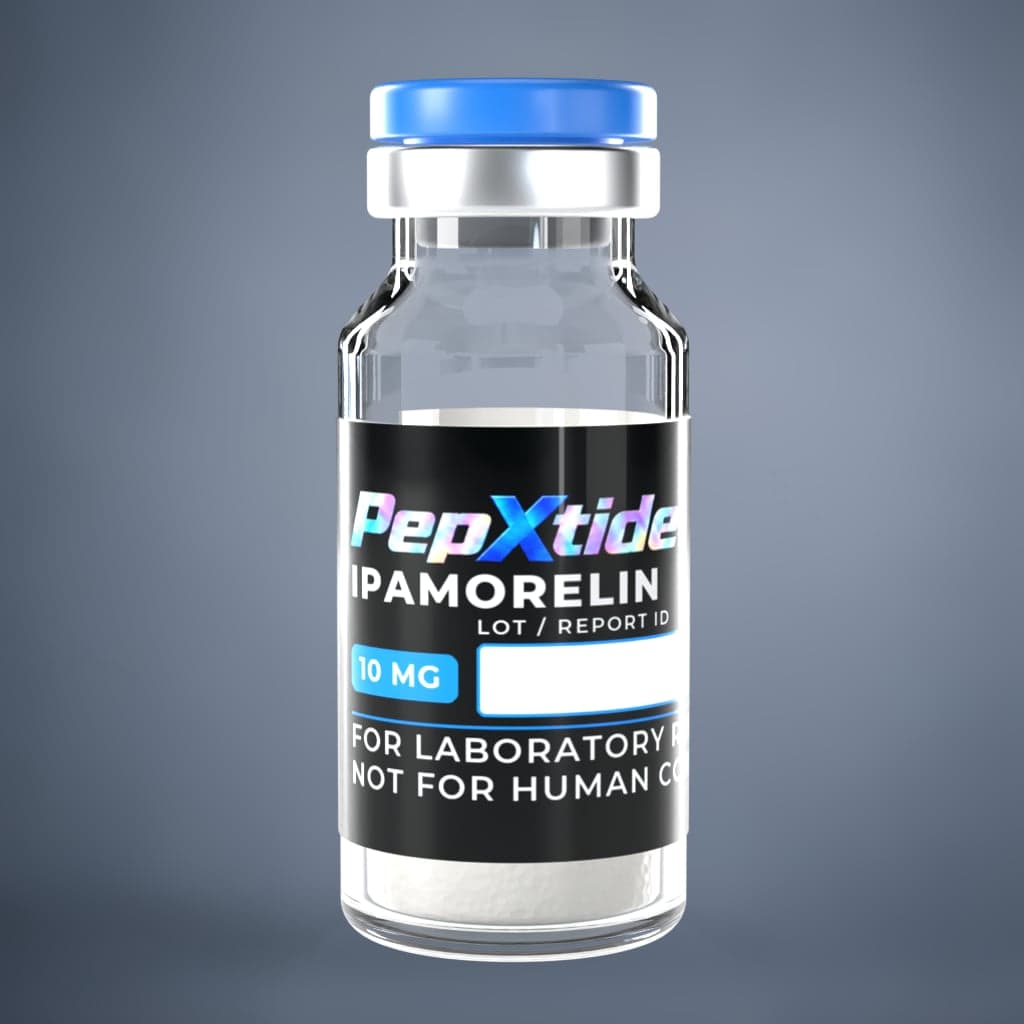
Growth & Secretagogue
Ipamorelin
Lyophilized powder
Research notice
Supplied for in-vitro laboratory research only. Not for human or veterinary consumption, and not evaluated by the FDA. No statement on this page describes an application, benefit, dose, route or outcome. Descriptions are structural and mechanistic, and reference data such as CAS numbers and molecular formulas is published information about the compound itself, provided for identification. No measured result is shown for this strength because a certificate has not yet been published for its lot.