

Research use only. This compound is supplied for in-vitro laboratory research by qualified researchers. It is not for human or veterinary consumption and has not been evaluated by the FDA.
Matrix & Cytoskeletal
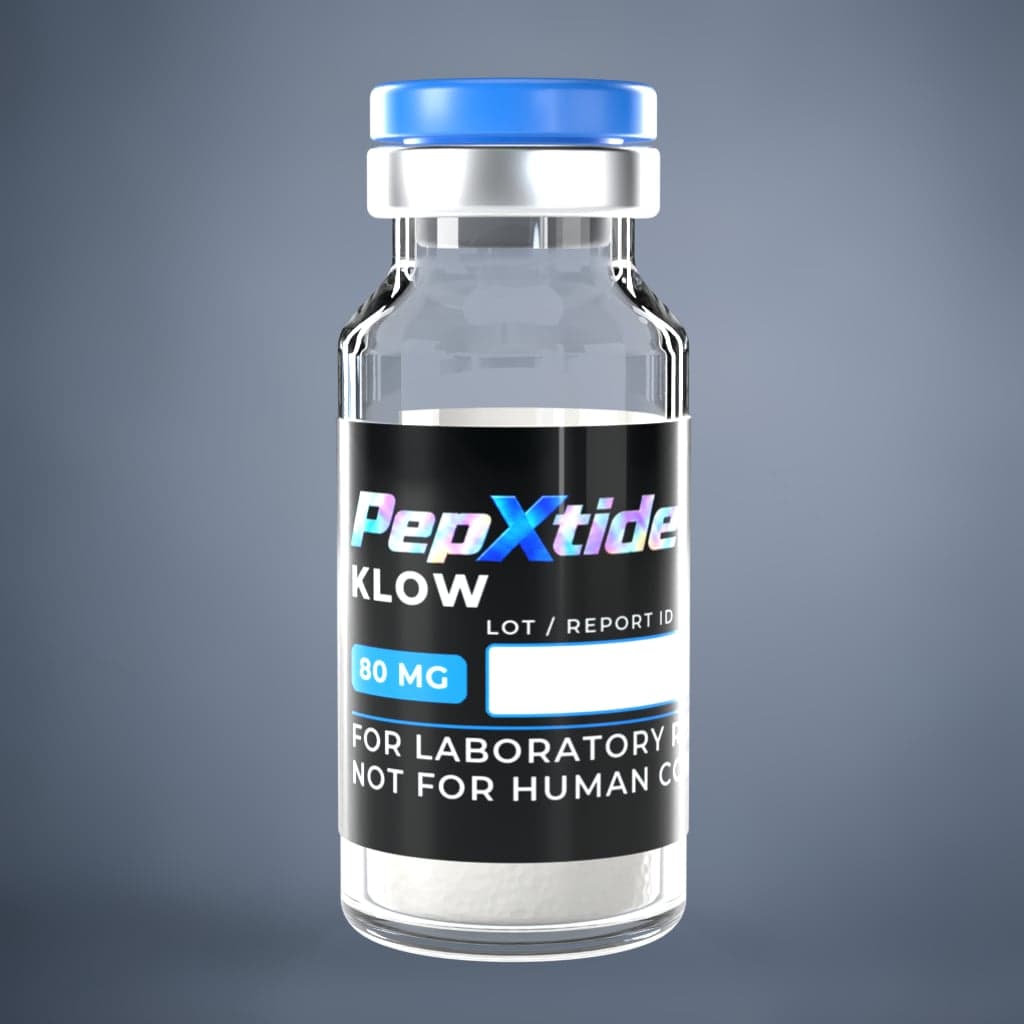
KLOW
Certificate pending · 80mg
80mg$139.99each
Certificate pending for the 80mg lot.The signed report will be published here as soon as the laboratory returns it.
Ordering at volume or on a schedule?
Request a supply quote →Buy more of this strength and the price comes down. The store applies it at checkout - there is nothing to enter.
Free US shipping - no minimum
Tell us the Report ID or Laboratory ID shown on the certificate, and what you observed. If independent testing shows a discrepancy against our published certificate, we refund the lot in full and pull it from sale pending investigation.
Tell us the Report ID or Laboratory ID shown on the certificate, and what you observed. If independent testing shows a discrepancy against our published certificate, we refund the lot in full and pull it from sale pending investigation.
Certificate pending
Discreet packaging
Dispatched within one business day
Free US shipping, no minimum
In stock, ships from our US fulfilment partner
Compound information
- Type
- Matrix & Cytoskeletal
- Sequence
- Blend: GHK-Cu, BPC-157, TB-500 and KPV
- Form
- Lyophilized powder blend
- Vial strength
- 80mg
- Catalogue number
- PX-KLOW-80MG
- Purity
- Certificate pending for this strength
Identifiers are published properties of the molecule. Values we cannot confirm are omitted rather than estimated.
KLOW is a blend rather than a single compound: GHK-Cu, BPC-157, TB-500 and KPV supplied together in one vial. Because it is a mixture it has no single CAS number, molecular formula or molecular weight, and any listing that gives it one is describing something else.
The PepXtide structural library shows it as a cluster of the four separate structures. They are not bonded to each other, and the rendering is deliberately arranged so that is obvious.
The four differ in kind, not only in sequence. GHK-Cu is a metal complex, in which copper(II) is coordinated by the glycine alpha-amino nitrogen, the deprotonated glycyl-histidyl amide nitrogen and the histidine imidazole nitrogen. BPC-157 and TB-500 are unmodified and N-acetylated peptides respectively, with no metal and no bridge. KPV is a three-residue free acid. One vial therefore contains a coordination compound and three ordinary peptides, and any analytical method applied to it has to cope with both.
That mixture of chemistries has a direct handling consequence. The copper centre in GHK-Cu is redox-active and can be reduced from copper(II) to copper(I), and free or loosely bound copper is a known catalyst of thiol and ascorbate oxidation. None of the other three components in this particular vial carries a thiol, so that specific reaction is not available here, but the presence of a redox-active metal alongside peptides is the reason a blend of this type should not be held warm, at alkaline pH, or in solution longer than an experiment requires.
No published study characterises the four-component mixture as an entity, and the citations shown on this page are papers about the individual components. As with every blend in this catalogue, the vial label states a combined mass, so a per-milligram figure is not comparable with the same figure for a single compound, and the site does not publish one.
Background
KLOW is a four-component blend, not a single molecule: GHK-Cu, BPC-157, TB-500 and KPV share one vial without being bonded to one another, so the mixture has no single CAS number, formula or molecular weight. The components differ in kind as well as sequence - GHK-Cu is a copper(II) coordination complex, BPC-157 is an unmodified peptide, TB-500 is N-acetylated and KPV is a three-residue free acid. No published study characterises the four-part mixture as an entity; the literature concerns the individual components.
Research applications
Where this compound appears in the published literature. Each area points to the papers listed under Primary literature below. These describe what was studied, not an application of this product.
BPC-157: musculoskeletal models
Studied in preclinical musculoskeletal and tendon models for the BPC-157 component, a body of work collected in two 2025 reviews from the orthopaedic literature, one of which reviews the reported preclinical findings alongside open questions about risk.[1][2]
GHK-Cu: matrix and gene-expression research
Studied in gene-expression and extracellular-matrix research for the GHK-Cu component, reviewed in a 2018 International Journal of Molecular Sciences article and a 2025 Bioimpacts review of GHK formulations.[4][3]
Thymosin beta-4: hepatic stellate cells
Examined in hepatic stellate cell research for thymosin beta-4, the parent protein of the TB-500 component, in a 2016 chapter in Vitamins and Hormones.[5]
Specifications
- Supplied as
- Lyophilized powder blend
- Available strengths
- 80mg
- Components
- GHK-Cu · BPC-157 · TB-500 · KPV
- Storage
- Store lyophilized at -20C, protected from light and moisture.
- Intended use
- In-vitro laboratory research only
Research overview
Four-peptide blend
A blend rather than a single molecule: GHK-Cu, BPC-157, TB-500 and KPV in one vial. Shown here as a cluster of the four separate structures - they are not bonded to each other.
Four separate peptides in one vial - shown together, not bonded to each other.
Primary literature
Peer-reviewed papers indexed on PubMed that study this compound. We did not write them and we do not summarise them — each reference opens the record on PubMed so you can read the work itself. Publication is not evidence of safety or efficacy, and none of this research was conducted by PepXtide.
This product is several peptides in one vial. The papers below study those peptides individually — none of them is research into this combination.
- HSS J, 2025 · PMID 40756949
- Curr Rev Musculoskelet Med, 2025 · PMID 40789979
- Bioimpacts, 2025 · PMID 39963574
- Int J Mol Sci, 2018 · PMID 29986520
- Vitam Horm, 2016 · PMID 27450733
PubMed, PubChem and ClinicalTrials.gov are independent scientific databases. A record or a published paper is not an endorsement of this product, and nothing indexed there describes an application, dose or outcome supported by PepXtide.
Storage & handling
Lyophilized
Store lyophilized at -20C, protected from light and moisture. One component is a copper(II) complex and the metal centre is redox-active, so the blend should be kept cold, dry and near neutral pH, and should not be held in solution longer than an experiment requires.
Reconstituted
Once reconstituted, keep refrigerated and use within the working period established by the laboratory.
Handling notes
- Store the lyophilized blend at -20C, protected from light and moisture.
- The copper(II) centre in GHK-Cu is redox-active, so keep the blend cold, dry and near neutral pH.
- Avoid holding the blend warm, at alkaline pH, or in solution longer than an experiment requires.
- Once reconstituted, keep refrigerated and use within the working period established by the laboratory.
- The vial label states a combined mass, so a per-milligram figure is not comparable with a single-compound vial.
Safety & handling
Bench handling, not a dosing guide.
Intended use
Supplied strictly as a laboratory research material for in-vitro study by qualified researchers. Not for human or veterinary use, not for ingestion or injection, and not for any clinical or diagnostic application.
Personal protective equipment
Handle with gloves, eye protection and a laboratory coat. Weigh and transfer lyophilized powder in a ventilated enclosure to avoid generating an inhalable dust.
Reconstitution
Reconstitute against the diluent and volume appropriate to your protocol, adding solvent slowly down the vial wall rather than directly onto the pellet. Do not shake. This is a handling note, not a dosing guide.
Storage after opening
Once reconstituted, refrigerate and use within the period appropriate to the material. Avoid repeated freeze-thaw cycles, which degrade peptides faster than continuous storage at the listed temperature.
Disposal
Dispose of material and containers in accordance with your institution's chemical waste procedures and applicable local regulations.
Related compounds
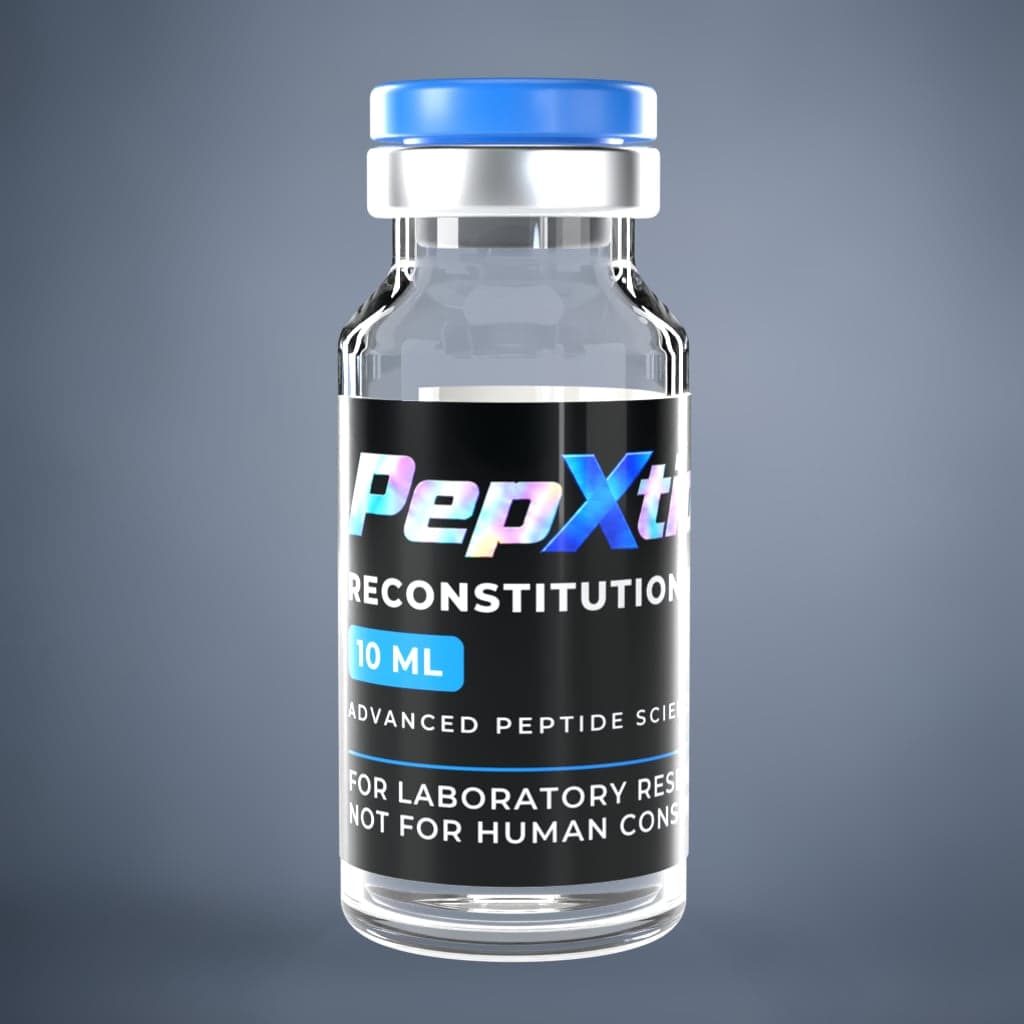
Research notice
Specifications for each component are on its own product page. Supplied as a lyophilized powder for in-vitro laboratory research only. No statement on this page describes an application, benefit, dose, route or outcome. Descriptions are structural and mechanistic, and reference data such as CAS numbers and molecular formulas is published information about the compound itself, provided for identification. No measured result is shown for this strength because a certificate has not yet been published for its lot.