Research use only. This compound is supplied for in-vitro laboratory research by qualified researchers. It is not for human or veterinary consumption and has not been evaluated by the FDA.
Buy more of this strength and the price comes down. The store applies it at checkout - there is nothing to enter.
Free US shipping - no minimum
Tell us the Report ID or Laboratory ID shown on the certificate, and what you observed. If independent testing shows a discrepancy against our published certificate, we refund the lot in full and pull it from sale pending investigation.
1
$149.99each
Tell us the Report ID or Laboratory ID shown on the certificate, and what you observed. If independent testing shows a discrepancy against our published certificate, we refund the lot in full and pull it from sale pending investigation.
Identifiers are published properties of the molecule. Values we cannot confirm are omitted rather than estimated.
MOTS-c is a sixteen-residue peptide encoded in mitochondrial DNA rather than the nuclear genome, which is unusual enough to be the reason it is studied at all. It is modelled as an alpha helix in the PepXtide structural library.
The coding sequence is a short open reading frame of 51 base pairs lying within MT-RNR1, the mitochondrial 12S ribosomal RNA gene, and the peptide was described in 2015 by a group at the University of Southern California. It has two better-known relatives from the same class of mitochondrially encoded short peptides: humanin, encoded within the 16S gene, and the small humanin-like peptides.
One point about its biosynthesis is routinely reported incorrectly and is worth getting right. Although the gene is mitochondrial, translation of the peptide takes place in the cytoplasm using the standard genetic code. The discovery paper states this explicitly and gives the reason: read with the mitochondria-specific genetic code, the reading frame yields tandem start and stop codons. The transcript is polyadenylated and exported from the mitochondrion. A description of this peptide as translated with the mitochondrial genetic code is a citable error.
The chain itself is entirely unmodified: sixteen residues, Met-Arg-Trp-Gln-Glu-Met-Gly-Tyr-Ile-Phe-Tyr-Pro-Arg-Lys-Leu-Arg, with free termini, no amidation, no lipidation, no bridge and no cysteine. The absence of cysteine does not make it chemically inert, however, because it contains two methionines and a tryptophan, all three of which are oxidation-prone, and oxidation products have been reported in validated bioanalytical work. Among the peptides in this catalogue it is one of the more oxidation-sensitive.
The described mechanism is metabolic rather than receptor-mediated, and no validated cell-surface receptor exists for it. Published work places its action on the methionine-folate cycle and the de novo purine biosynthesis pathway tethered to it, with accumulation of the intermediate AICAR and consequent phosphorylation of AMP-activated protein kinase at threonine 172. A second, nuclear arm has been reported, in which the peptide translocates to the nucleus under metabolic stress in an AMPK-dependent manner and participates in the regulation of antioxidant-response-element genes alongside NRF2. Several transcription factors named in that work were identified by motif enrichment rather than demonstrated binding, and should be read as inferences.
Analytical work on the peptide is well developed. A plasma LC-MS/MS method validated to international laboratory standards reports a detection limit around 100 picograms per millilitre and identifies four metabolites plus two oxidation products. Worth knowing before designing an experiment: a commercial immunoassay for this peptide gave concentrations that could not be confirmed by mass spectrometry, so quantitation should rest on a chromatographic method.
Background
MOTS-c is a sixteen-residue peptide encoded by a short open reading frame inside the mitochondrial 12S rRNA gene (MT-RNR1), described in 2015 and related to humanin and the small humanin-like peptides. Despite its mitochondrial origin, it is translated in the cytoplasm using the standard genetic code. The chain is unmodified, and no cell-surface receptor has been validated; published mechanistic work places it on the methionine-folate cycle, AICAR accumulation and AMPK phosphorylation, with a reported nuclear role alongside NRF2.
Research applications
Where this compound appears in the published literature. Each area points to the papers listed under Primary literature below. These describe what was studied, not an application of this product.
Metabolic research
Studied in metabolic research, reviewed in 2023 articles in Frontiers in Endocrinology and Metabolites.[1][2]
Diabetes and ageing-related research
Examined in diabetes and ageing-related disease research, reviewed in a 2023 Diabetes and Metabolism Journal article.[4]
Bone metabolism
Investigated in bone metabolism research, summarised in a 2023 review in Frontiers in Physiology.[3]
Mitochondrial-nuclear signalling
Characterised as a mitochondrial-encoded regulator of the nucleus in a 2019 Bioessays review.[5]
Specifications
Supplied as
Lyophilized powder
Available strengths
40mg
CAS number
1627580-64-6
Molecular formula
C101H152N28O22S2
Storage
Store lyophilized at -20C, protected from light and moisture.
Intended use
In-vitro laboratory research only
Research overview
Mitochondrial-derived peptide
A 16-residue peptide encoded in mitochondrial DNA rather than the nuclear genome. Investigated in metabolic research around glucose handling and the exercise response. Modelled as an alpha helix.
Residues
16
Atoms
153
Primary literature
Peer-reviewed papers indexed on PubMed that study this compound. We did not write them and we do not summarise them — each reference opens the record on PubMed so you can read the work itself. Publication is not evidence of safety or efficacy, and none of this research was conducted by PepXtide.
The list above is a selection, not the whole literature. These open the public databases themselves, each one confirmed to return results on 29 August 2026.
PubMed, PubChem and ClinicalTrials.gov are independent scientific databases. A record or a published paper is not an endorsement of this product, and nothing indexed there describes an application, dose or outcome supported by PepXtide.
Storage & handling
Lyophilized
Store lyophilized at -20C, protected from light and moisture. The sequence carries two methionines and a tryptophan, all oxidation-prone, and oxidation products have been reported in validated bioanalytical work, so minimising headspace air and avoiding prolonged storage in solution matter more here than for most peptides in the catalogue.
Reconstituted
Once reconstituted, keep refrigerated and use within the working period established by the laboratory.
Handling notes
Store lyophilized at -20C, protected from light and moisture.
Two methionines and a tryptophan are oxidation-prone, and oxidation products have been reported in validated bioanalytical work.
Minimise headspace air and avoid prolonged storage in solution.
Once reconstituted, keep refrigerated and use within the working period established by the laboratory.
Quantitation should rest on a chromatographic method; a commercial immunoassay gave values that mass spectrometry could not confirm.
Safety & handling
Bench handling, not a dosing guide.
Intended use
Supplied strictly as a laboratory research material for in-vitro study by qualified researchers. Not for human or veterinary use, not for ingestion or injection, and not for any clinical or diagnostic application.
Personal protective equipment
Handle with gloves, eye protection and a laboratory coat. Weigh and transfer lyophilized powder in a ventilated enclosure to avoid generating an inhalable dust.
Reconstitution
Reconstitute against the diluent and volume appropriate to your protocol, adding solvent slowly down the vial wall rather than directly onto the pellet. Do not shake. This is a handling note, not a dosing guide.
Storage after opening
Once reconstituted, refrigerate and use within the period appropriate to the material. Avoid repeated freeze-thaw cycles, which degrade peptides faster than continuous storage at the listed temperature.
Disposal
Dispose of material and containers in accordance with your institution's chemical waste procedures and applicable local regulations.
Also sold as part of a set
40mg
50mg
10mg
10ml
Metabolic Research · 4 vials
MOTS-c, 5-Amino-1MQ and AOD-9604 Set
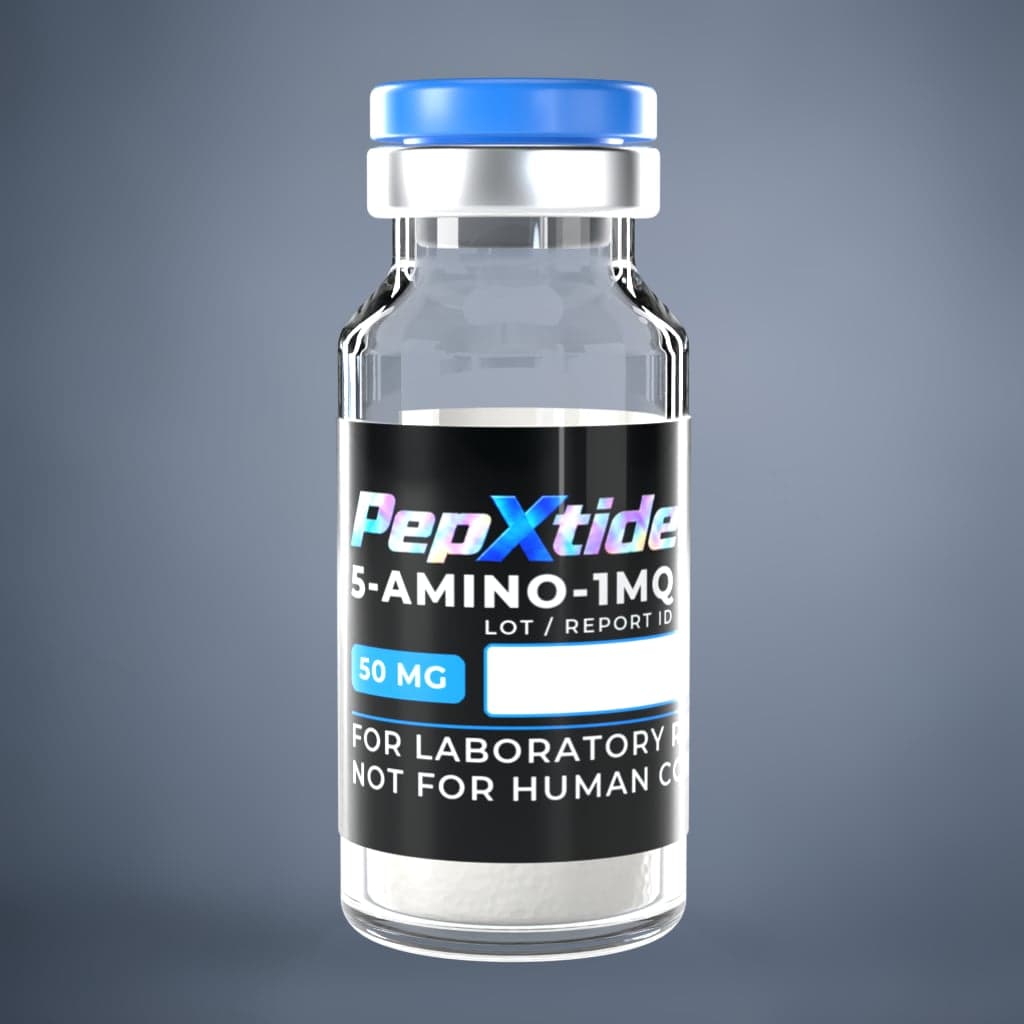
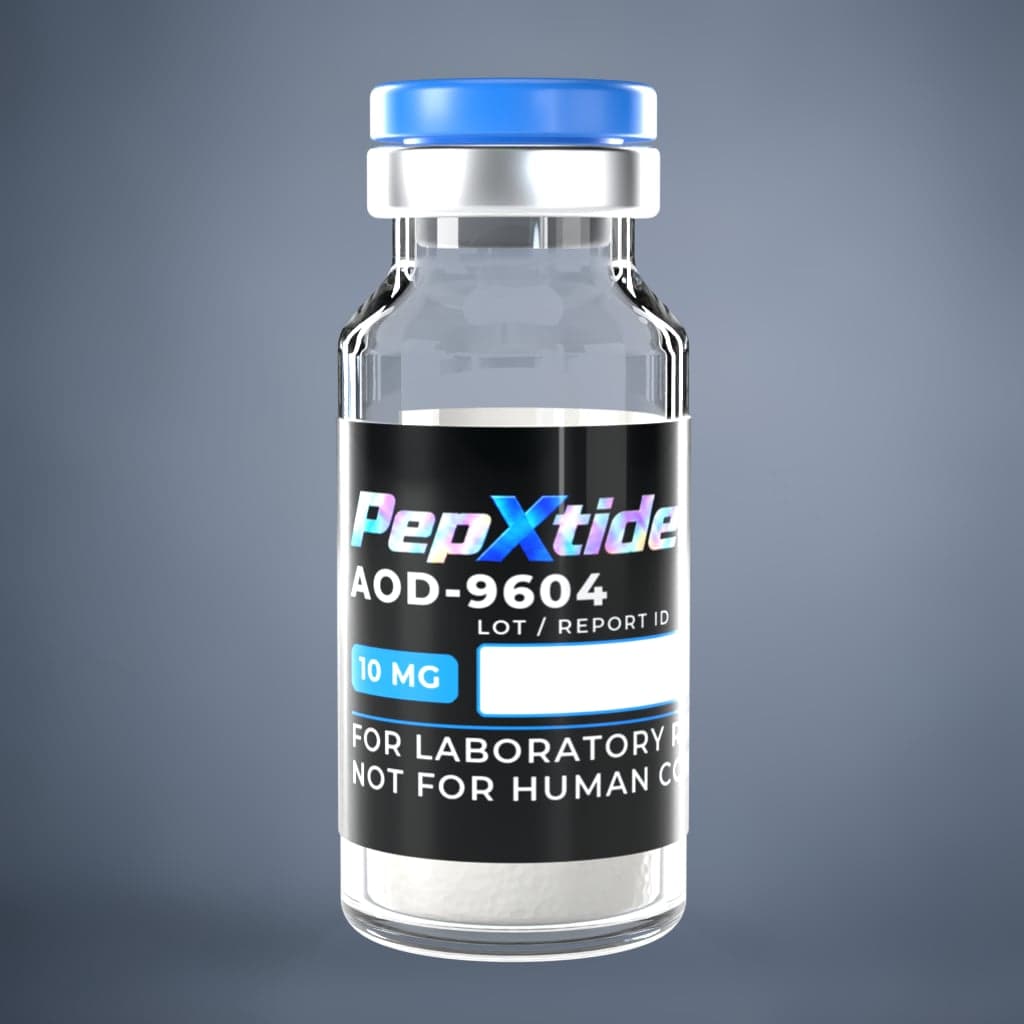
A mitochondrial-derived peptide at 40mg, a small molecule at 50mg and a 16-residue fragment at 10mg, plus water.
On its own this set comes to $318.72 at checkout: $56.24 Bundle & Save is taken off there.
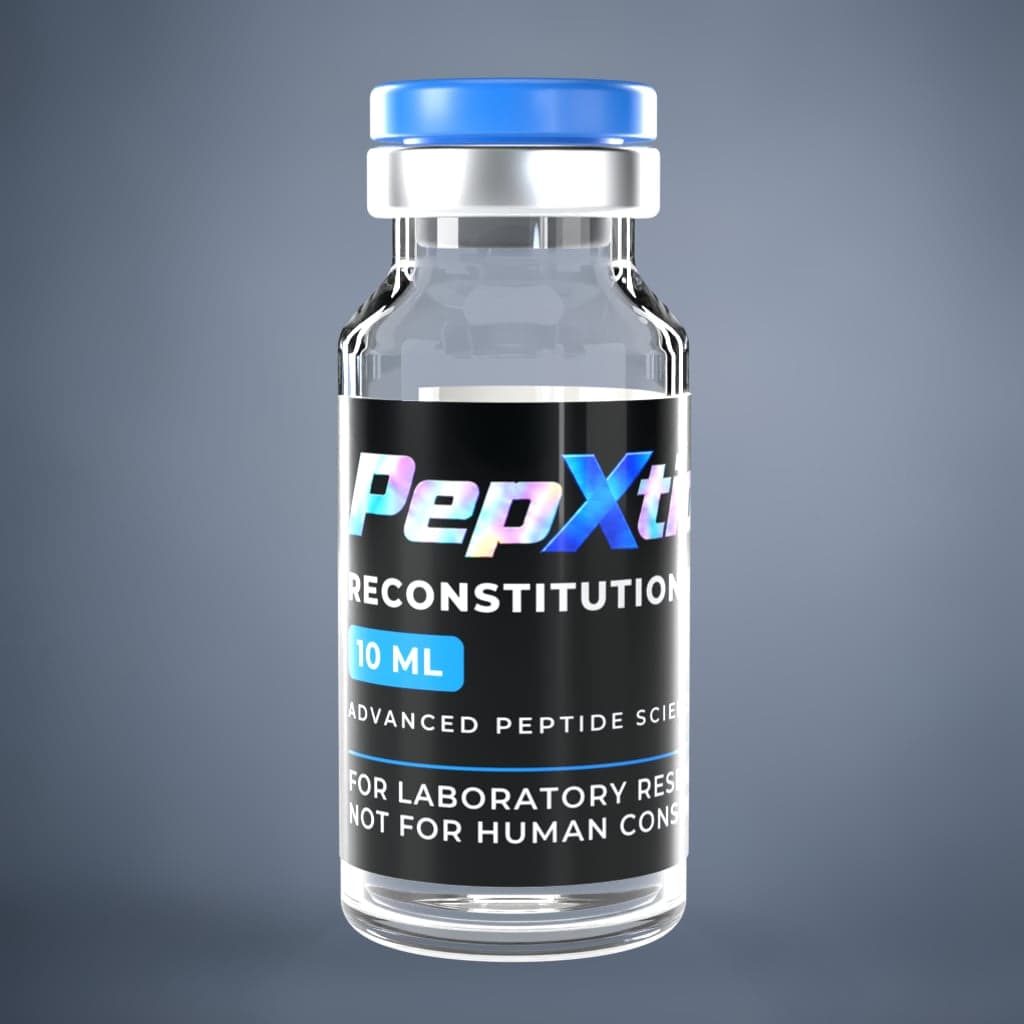
MOTS-c at 40mg, 5-Amino-1MQ at 50mg, AOD-9604 at 10mg and a 10ml bacteriostatic water vial. The three compounds are chemically unrelated to each other beyond sharing a catalogue category, and they ship as separate vials, each with its own certificate status. Each is stocked in one size only, which is the size this set uses.
A 16-residue mitochondrial-derived peptide, a small-molecule compound and a 16-residue growth-hormone fragment, all listed under Metabolic Research.
Adds 4 separate cart lines. Remove any one of them in the cart.
Supplied as a lyophilized powder for in-vitro laboratory research only. No statement on this page describes an application, benefit, dose, route or outcome. Descriptions are structural and mechanistic, and reference data such as CAS numbers and molecular formulas is published information about the compound itself, provided for identification. The certificate shown above is the testing laboratory's report V260305-15-006 for this strength; its results are for that report only and are not averaged across the product line.


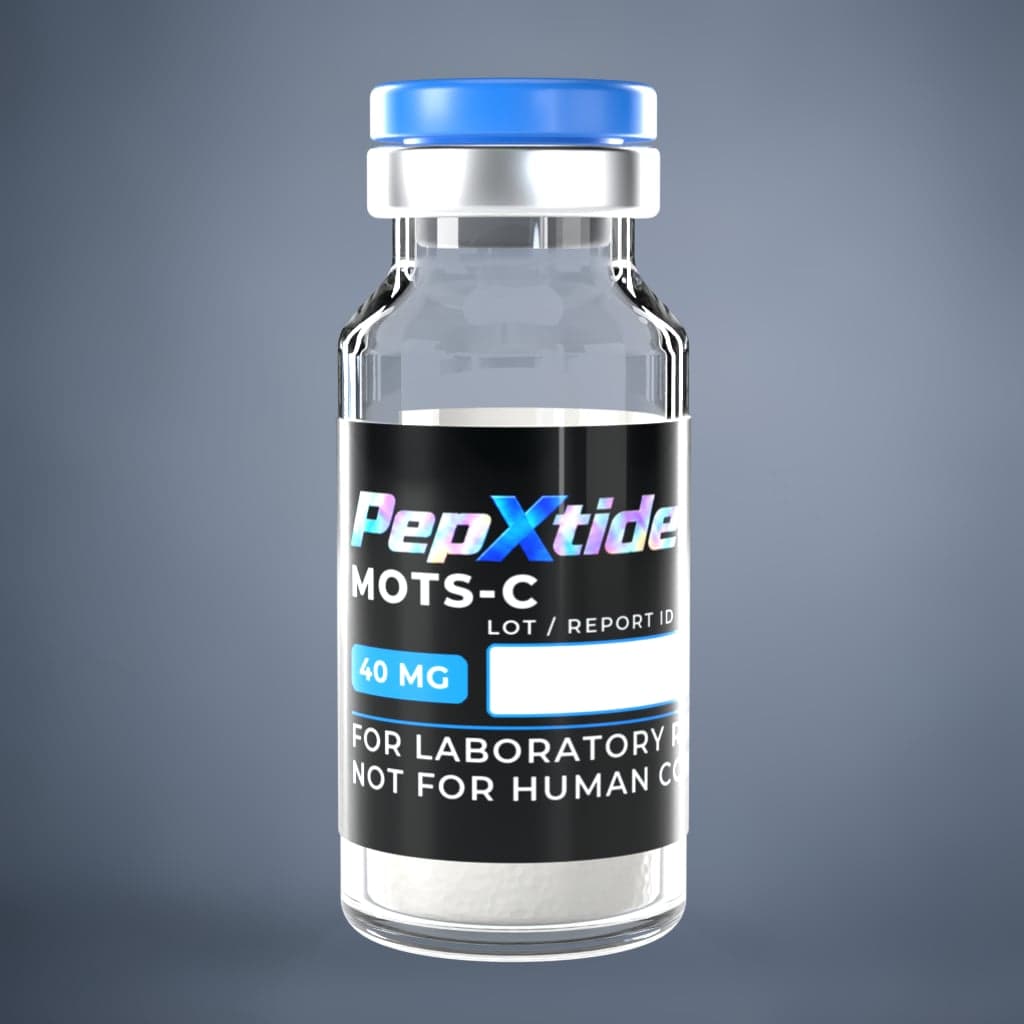 40mg
 50mg
 10mg
 10ml